
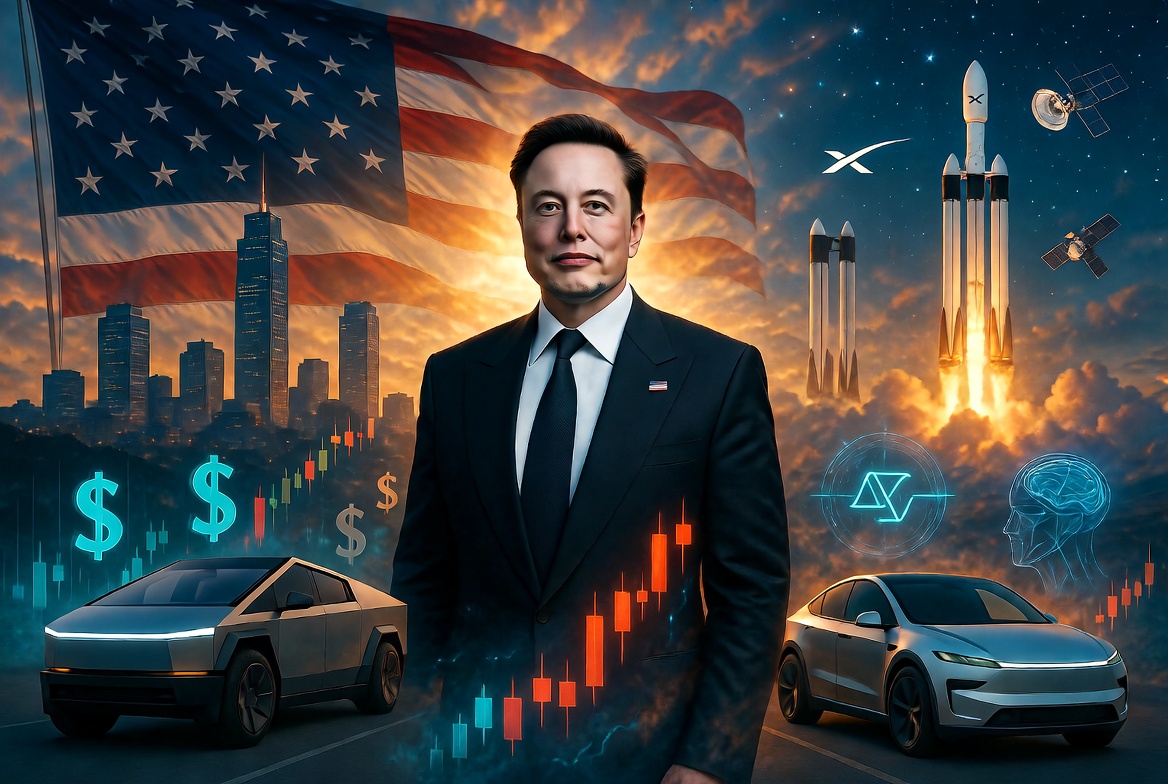
Those who obsess over Elon Musk becoming the world’s first trillionaire are angry at the wrong number. His trillion-dollar fortune, astonishing as it is, is almost beside the point. The far more remarkable fact is that even a trillion dollars dramatically understates the amount of wealth he has actually created. Understand that Musk’s personal fortune reflects only the shares he still owns in the companies he built. It barely begins to capture the economic value of those companies themselves, the millions of livelihoods they support, or the trillions of dollars in productive assets that simply would not exist but for his willingness to imagine them into existence.
Consider the numbers. Elon Musk owns only a minority stake in both Tesla and SpaceX, the two companies responsible for the overwhelming majority of his fortune. He owns roughly fifteen percent of Tesla and approximately forty percent of SpaceX. Those ownership interests may make him the richest man in history, but they represent only a fraction of the value of the enterprises themselves. Tesla alone is worth roughly $1.5 trillion. SpaceX is worth another $2.5 trillion. Taken together, those two companies represent approximately four trillion dollars in market value. That is four trillion dollars in wealth that did not exist a few decades ago. It was created through engineering, innovation, investment, and the coordinated efforts of hundreds of thousands of employees brought together under Musk’s leadership. His personal fortune is merely the slice of that value he still happens to own.
And most importantly, nobody got poor when this wealth was created. Nobody lost $4 trillion in the process. In fact, the only people who ever lose with respect to Musk are those who bet against him. That wealth simply did not exist before Tesla and SpaceX. It came into existence because millions of people voluntarily concluded that the products and services those companies created were worth more than the money they exchanged for them.
That number is so large that it becomes difficult to comprehend. Four trillion dollars is roughly the annual economic output of countries such as Japan or Germany. It is approximately equal to the combined economies of Russia and Australia. It is roughly twice the economic output of Italy or Brazil. These are medium-sized economies we’re talking about! Musk is not literally a country, but the enterprises he has helped create now rival entire nations in economic significance.
Now, before all the amateur economists begin sharpening their pencils, market capitalization is not the same thing as gross domestic product. GDP measures the value of goods and services produced during a single year. Market capitalization represents investors’ collective assessment of what a company is worth based upon its future earning potential. They measure different things. Yet the comparison remains useful because it illustrates the sheer magnitude of what has been built, and people he supports.
The impact extends far beyond balance sheets and stock prices. Musk’s companies directly employ roughly 150,000 workers, at a cost of roughly $20 billion per year. Add the contractors, suppliers, logistics companies, manufacturers, construction firms, and countless third-party businesses that exist because Tesla and SpaceX exist, and the number of jobs supported climbs into the neighborhood of one million. Those workers, in turn, support families. Using ordinary household sizes, it is entirely reasonable to estimate that roughly four million people derive some portion of their livelihood, directly or indirectly, from enterprises Musk helped build. Four million people is roughly the population of Chicago, Houston, or Madrid, and larger than Puerto Rico. If all of those people constituted a state, it would rank around the middle of the nation in population, somewhere between Oklahoma and Connecticut. And that does not even account for the economic activity generated by those four million people as they purchase homes, buy groceries, dine in restaurants, visit physicians, pay taxes, patronize local businesses, and create still more jobs through their own spending.
It is no exaggeration to say that Musk is effectively an economy within an economy. I say this in jest, but maybe instead of criticizing Musk, we should award him two senators and a handful of members of Congress to represent all the people in the Great State of Musk!
Now, it is fashionable today to look upon these numbers with suspicion rather than admiration. We have become strangely uncomfortable with extraordinary success, as though creating immense value were itself evidence of exploitation. Yet when one person creates enterprises that support the livelihoods of millions, perhaps our first instinct should not be to ask how much of his wealth government can confiscate, but how this level of success can be replicated by others.
So no, I don’t want the government confiscating ownership from Musk in order to fund social welfare programs that never elevate anyone from poverty, because Musk is himself a giant, self-sustaining social welfare program, that runs far more efficiently, provides far more abundantly, and allocates resources far more productively, than politicians who have never created anything. Productive enterprise is itself the greatest social welfare program ever devised. I don’t want businesses contributing to a welfare state, I want businesses investing their money, hiring people and expanding their operations, so that fewer people rely on the welfare state.
I know this does not make for a great campaign slogan, but billionaires are not the problem, they are the solution. Wealth is not a problem to be solved. It is a phenomenon to be studied, encouraged, incentivized, and celebrated. Give us two or three more Elon Musks and we’ll solve poverty in this country for generations!
But good economics makes for bad politics, so it’s more useful to vilify the successful and insist they are “hoarding” money. Forgetting the obvious economic fallacy (how is a company increasing in value tantamount to hoarding anything), this should be plainly refuted on its face for two reasons: first, if billionaires are hoarding money, we would be experiencing massive deflation from all the money that left circulation. Money that is locked away cannot bid up the price of homes, stocks, automobiles, or groceries. But asset prices have climbed, housing has become more expensive, and the cost of everyday necessities has risen. Whatever explains those phenomena, they disprove the narrative that money is being locked away in vaults.
More fundamentally, if Musk is hoarding his money, then how is he paying all of these employees? How is he paying for all of these factories and materials? If anything, Musk gives away more money than anyone through the investment he makes in workers, capital improvement, and innovation.
It is an indictment, not of the wealthy but of ourselves, that we increasingly speak about wealth as though it were a moral offense rather than an economic achievement. Somewhere along the way we stopped asking, “How was this fortune created?” and began asking only, “How large is it?” Those are profoundly different questions. A fortune acquired through fraud, political favoritism, or monopoly deserves scrutiny. A fortune earned by creating products that millions of people voluntarily choose to buy deserves admiration, because it tells us that someone has discovered a better way of improving the human condition than existed before. Capitalism rewards value creation precisely because value creation improves human life.
None of this means that questions surrounding inequality, taxation, or corporate power are illegitimate. They are not. A serious society should constantly ask whether tax laws are fair, whether markets remain genuinely competitive, whether monopolistic behavior should be restrained, and whether prosperity is being broadly shared. Those are worthy debates because they concern the proper relationship between capital, labor, and government.
What is not worthy of serious debate is the fairy tale that billionaire wealth consists of piles of inert money selfishly withheld from everyone else, that serves no productive good, and would be better off in the hands of politicians — those pillars of virtue and economic understanding — who create nothing, and risk nothing. It may be emotionally satisfying to turn economics into a morality play populated by heroes and villains. But economics is more complicated than children’s literature.
Every civilization ultimately faces the same choice. It can celebrate the people who create wealth, or it can resent them. It can encourage innovation, investment, and entrepreneurship, or it can punish them. History has shown, time and again, that the prosperous societies are those which recognize that wealth is not the disease. poverty is, wealth is the cure. The societies that forget that distinction do not become more equal. They simply become poorer together.
- The Warmth of Collectivism, and Other Socialist Absurdities – Conservative Opinion
- Bernie Sanders: Patron Saint of the Privileged – Conservative Opinion
- When Romney Says “Tax the Rich Like Me,” He Means You – Conservative Opinion
- What Ayn Rand Got Wrong, and Capra Got Right, About Capitalism – Conservative Opinion