
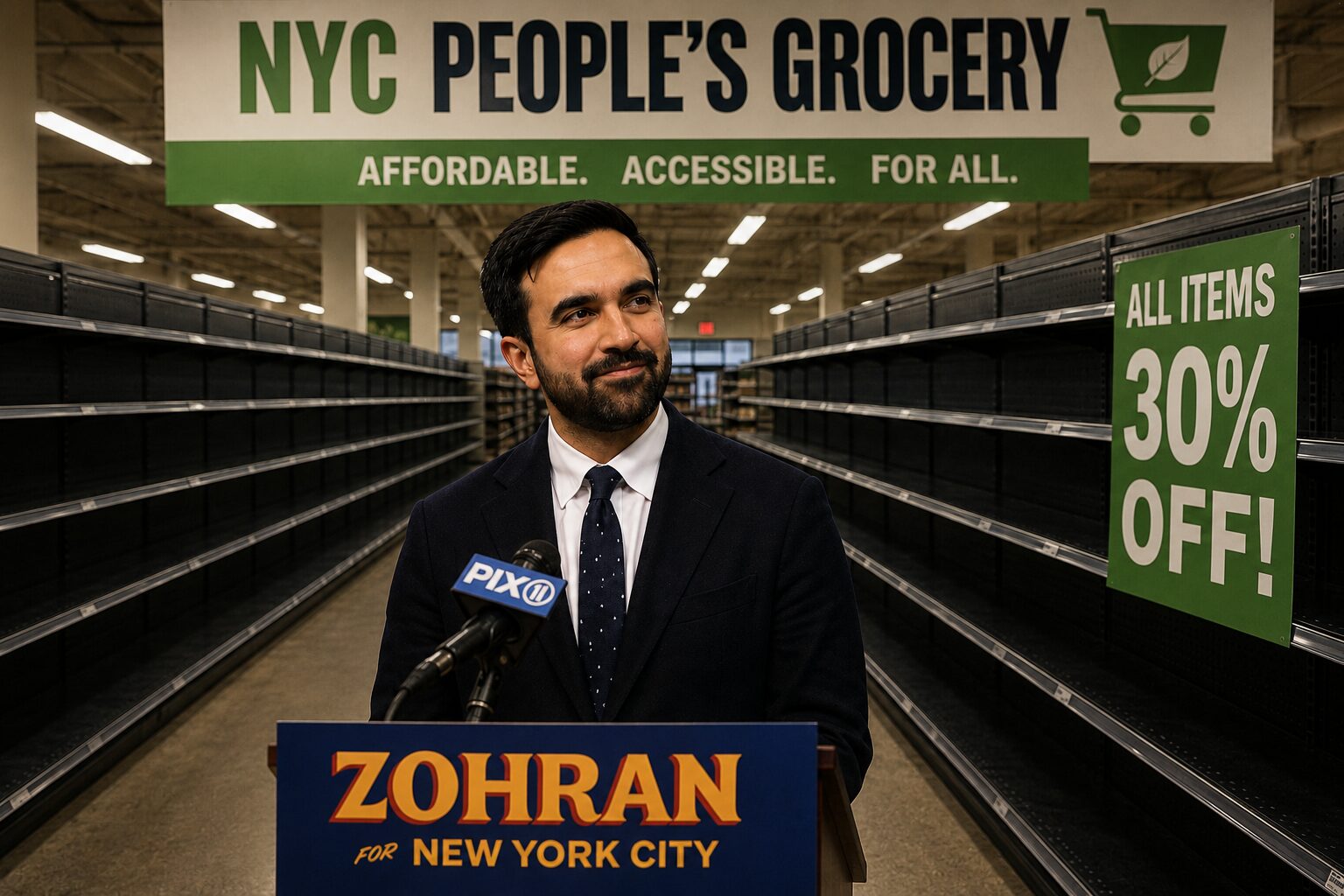
The most seductive political ideas are rarely the most wicked. They are the ones that seem so obviously compassionate that questioning them appears almost indecent. Zohran Mamdani’s proposal for government-owned grocery stores belongs squarely within that distinguished tradition.
This idea is nothing new, of course. Every generation produces politicians convinced that they have finally discovered a means of suspending one of the ordinary laws of economics. Their proposals differ and their rhetoric evolves, but their results are remarkably consistent. Government-owned grocery stores are merely the latest invitation to relearn a lesson that markets have been teaching for centuries: that while politicians possess the authority to pass laws that govern men, they do not possess the authority to repeal laws of nature. They may repeal statutes, regulations, ordinances, and executive orders with astonishing frequency. The law of supply and demand is not among them. It requires no legislature, recognizes no governor, acknowledges no mayor, and is entirely indifferent to election results. Mr. Mamdani is free to challenge it if he wishes, and best of luck. It has defeated every challenger before him.
Before proceeding, it is worth clarifying what I mean when I predict that Mr. Mamdani’s grocery stores will fail. I do not mean that they will close their doors, liquidate their inventory, and quietly disappear into the catalogue of abandoned municipal experiments. On the contrary, I suspect they will endure for decades. Government programs possess a curious quality that private enterprises do not. A business that persistently loses money eventually exhausts its capital and closes its doors. A government program that persistently loses money is generally awarded a larger appropriation. Its deficits become evidence not that the enterprise has failed, but that it has not yet been funded adequately. Its disappointments become arguments for expansion rather than retrenchment.
In this respect, government grocery stores will almost certainly resemble every other entitlement program. Once the public becomes accustomed to receiving a subsidized benefit, withdrawing it becomes politically more difficult than creating it was in the first place. Programs that begin as temporary measures, pilot projects, or emergency interventions have an extraordinary tendency to become permanent features of the political landscape. We could experience complete nuclear annihilation and the only two things that would survive would be cockroaches and entitlement programs.
No, the failure I predict is of a different kind. It will fail because it will not accomplish what its advocates promise. It will not become a self-sustaining alternative to the private market. It will require continuing public subsidies to conceal costs that the market ordinarily displays openly. It will generate shortages whenever demand outruns subsidized supply, and indeed, these shortages will simply prove the popularity of the program. It will invite rationing, resale, and bureaucratic controls that no ordinary supermarket requires. In the end, New York will not have discovered a cheaper way to sell groceries. It will merely have discovered a more expensive way to disguise their true cost, and in the process, succeed not at solving a problem, but creating yet another entitlement program.
Supply and demand is often spoken of as though it were merely another theory among many competing theories. It is nothing of the sort. It is an observation of human behavior so consistently confirmed that it occupies much the same place in economics as gravity occupies in physics. Whenever the price of a good is held below its market-clearing level, demand inevitably exceeds supply, leading to a shortage. Consumers purchase more because the good has become artificially inexpensive, while producers possess less incentive to devote scarce resources toward producing it. There is nothing ideological about this proposition. It is equally true whether one is discussing apartments in Manhattan, gasoline in the 1970s, foreign currency in Argentina, food in Venezuela, or groceries in New York City. The identities of the politicians change, but human nature does not.
This is the first difficulty confronting Mr. Mamdani’s proposal. The city may certainly declare that groceries ought to cost thirty percent less than they presently do, but such a declaration alters only the price printed on the shelf. It does not reduce the cost of growing lettuce in California, transporting oranges from Florida, refrigerating meat, paying cashiers, maintaining delivery fleets, or compensating the thousands of people whose labor brings food from field to checkout counter. The supermarket shelf is not stocked because someone in Albany or Washington decreed that it should be. It is stocked because prices quietly coordinate an unimaginably complex web of farmers, truck drivers, warehouse operators, wholesalers, insurers, retailers, financiers, and consumers, each responding to incentives that no legislature created and no legislature can abolish. If those underlying costs remain substantially unchanged while groceries are sold at a significant discount, then one of only two things can happen. Either taxpayers quietly absorb the difference through subsidies that merely conceal the true cost of the groceries, or the stores attempt to operate below the market price without replacing the missing revenue. The first merely shifts the burden from the checkout line to the tax bill. The second invites consequences that have been understood since long before Karl Marx first put pen to paper.
Nor does the story end there, because human beings are as responsive to opportunity as they are to necessity. If identical goods are available in one location at prices significantly below those prevailing elsewhere, the difference itself becomes a commodity. People will buy more than they need because now they can afford to do so. Others will purchase those goods not because they wish to consume them, but because they wishes to resell them, and profit from the spread between the government’s price and the market’s price.
Indeed, one of the more curious features of price controls is that they do not abolish rationing so much as change its form. Under ordinary market conditions, a consumer may object that groceries have become painfully expensive, but he can generally find them. Under artificially suppressed prices, however, the complaint gradually changes. The shelves are empty, the line is too long, and the store has sold out. What had previously been rationed by price is now rationed by scarcity. So what begins as a public grocery store inevitably requires purchase limits, identification requirements, enforcement mechanisms, and bureaucratic supervision, not because such measures were originally intended, but because they become necessary to restrain incentives that the artificially low prices themselves have created.
None of this is to suggest that government can never operate a grocery store. There are isolated rural communities where no private supermarket can profitably exist and where public intervention may represent the least undesirable alternative. In such places, government is filling a void left by the absence of a functioning market rather than attempting to improve upon one that already exists. New York City presents the opposite case. It is one of the most densely populated retail environments on earth, containing thousands of supermarkets, neighborhood groceries, bodegas, wholesalers, and specialty food markets competing daily for customers. The city’s difficulty is not that capitalism has failed to place food within reach of its residents. Its difficulty is that food, like every other scarce resource, has become more expensive.
If the genius of free market capitalism is that it produces unmatched abundance without any central coordination (indeed, precisely because there is no central coordination), the peculiar genius of socialism is its ability to exempt itself from the ordinary rules of evidence, forever presenting itself not as a theory repeatedly disproven by history, but as an experiment that has simply not yet been attempted by the right people. Every failure is dismissed as an imperfect implementation, while every new advocate assures us that this time, at last, the experiment will be conducted correctly. Most ideas are eventually abandoned when experience repeatedly contradicts them. Socialism alone seems to acquire fresh confidence with every disappointment, always insisting that history has not refuted the theory but merely deprived it of the proper custodians.
Mr. Mamdani’s grocery stores will therefore accomplish something in addition to this new entitlement, though almost certainly not what their advocates intend. They will provide yet another demonstration that markets are not clever inventions of capitalism but spontaneous expressions of human behavior, and that the laws governing them possess a remarkable indifference to political fashion. Every generation seems convinced that it has finally discovered the formula by which government may suspend those laws in the service of a noble cause. Every generation eventually discovers the same humbling truth. Nature, whether physical or economic, is under no obligation to yield to our aspirations simply because they have been enacted into law.
You may also be interested in:
- The Warmth of Collectivism, and Other Socialist Absurdities – Conservative Opinion
- Bernie Sanders: Patron Saint of the Privileged – Conservative Opinion
- A Conservative Call for a Department for Humane Living – Conservative Opinion
- What Ayn Rand Got Wrong, and Capra Got Right, About Capitalism – Conservative Opinion