
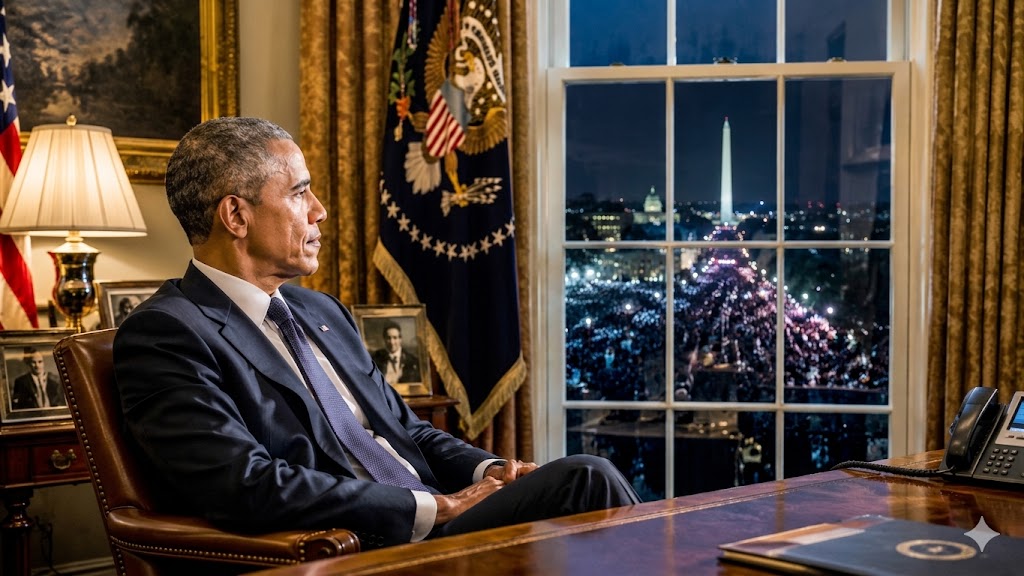
Obama was not the first of a new breed, but the last of the old guard.
There is something oddly revealing about the modern Democratic Party’s relationship with Barack Obama. Democrats still admire him, still summon him for campaigns, still place him in the same soft-focus category as Joe Biden whenever they wish to contrast Democratic “decency” with the chaos of Donald Trump. But almost nobody in the party seems interested in becoming the next Obama, or even looking for one. In an era where mere partisanship is not rewarded nearly as much as unrestricted warfare on the other side, Obama, with his stubborn insistence that Republicans are opponents but not enemies, that America is better when we are all together (how quaint!), and that it is flawed but nevertheless worth preserving, has become less a political model than a political credential, a familiar and comforting symbol of the pre-Trump era rather than a blueprint for the Democratic future.
For while Obama was a liberal, the new generation is Leftist, and there are important distinctions. The former is still tethered to certain norms in a tug-of-war with the Right that keeps things relatively centered; hence Obama’s belief that America needs “to have two healthy parties.” But the latter finds those very norms to be repugnant, and like all radical movements, it wants permanent one-party rule, and the humiliation of its opponents. Obama, in that sense, was not the first of a new breed, but the last of the old guard.
This is especially noteworthy because Obama was, just a few election cycles ago, presented as the future of the Democratic Party itself. He was supposed to usher in a new generation of politics: cooler, more intellectual, more cosmopolitan, more technologically sophisticated, less provincial, and, though decidedly partisan, he did at least try to build consensus as long as the consensus agreed with him. But he was not introduced to Americans as a revolutionary in the mold of Bernie Sanders, nor as an activist-warrior in the style of Alexandria Ocasio-Cortez, nor did he use flagrantly Marxist language like Zohran “Warmth of Collectivism” Mamdani, and, unlike significant parts of the emergent Left, he instinctively recoiled from the romanticization of political violence. His entire modus operandi was to present himself as safe and non-threatening, the chill, hyper-competent professor who could explain America back to itself.
Yes, Obama could be deeply condescending. One always sensed that he regarded conservatives not so much as malicious as insufficiently enlightened, like students who had simply not yet arrived at the correct conclusions. His speeches often carried the faintly smug tone of a graduate seminar conducted by a man slightly disappointed that the rest of the class had not done the reading. Yet despite profound disagreements many of us still have with his presidency, Obama nevertheless operated within a political framework that now feels strangely old-fashioned, because for all of his liberalism, he believed America was fundamentally one country, and worth building up rather than tearing down.
That may sound embarrassingly obvious, but it no longer is. Obama did not speak as though he were merely the commander of one ideological tribe in a permanent cold civil war against another. He certainly criticized Republicans, sometimes unfairly, and he was, and sadly still is, more than willing to advance thin or politically convenient narratives when it suited him or his party. But he still seemed to regard conservatives as fellow Americans participating in a shared national enterprise, however misguided he may have thought us to be. We were the embarrassing siblings, but nevertheless still family. He wanted to persuade us, outmaneuver us, perhaps embarrass us intellectually (good luck), but not morally exile us from the American story itself.
That distinction matters because much of the modern activist Left no longer seems to think that way at all. To many of today’s progressives, political opposition is not simply mistaken; it is illegitimate. It’s a betrayal even to have conservative friends. Republicans are not merely wrong but dangerous, authoritarian, hateful, and morally diseased. Moderation is weakness, compromise is surrender, and institutional restraint is complicity. Politics is no longer understood as the frustrating process of governing a diverse republic, but as an existential struggle between oppressors and victims in which defeat carries moral catastrophe. Obama wanted admiration. The newer movement wants conquest. Obama believed educated technocrats should responsibly guide institutions. The newer activists increasingly see institutions as weapons to seize, purge, and wield.
And this is where the strange irony of Obama’s legacy begins to emerge. For all the accusations conservatives made against him, and many were deserved, Obama now appears less like the father of the modern Democratic Party than like the last dignified, if solipsistic, representative of an older one.
I once wrote that Obama made Bill Clinton look like Ronald Reagan, and I stand by the central argument. Obama undeniably accelerated the Democratic Party’s movement away from Clinton-era moderation that worked with Republicans and famously declared “the era of big government is over,” and toward a far more progressive politics. He helped normalize identity-centered political rhetoric, and encouraged a style of discourse that increasingly divided Americans into categories of enlightenment and backwardness. But even that is far superior to dividing the country into good and evil, and it’s his reluctance to do so that has cost him stature among the emerging Left.
Obama was certainly not a conservative in the sense that he believed in lower taxes, fewer regulations, traditional social values, American exceptionalism, and courts committed to applying the law rather than bending it to advance causes that lawmakers would not. But he was conservative in the sense that he was institutionally cautious. He understood the importance of alliances abroad. He generally treated the courts as legitimate even when they frustrated him. He waged ruthless, unrelenting warfare on terrorists rather than challenge the military establishment. And when Congress resisted military intervention in Syria, he backed down rather than simply inventing authority he did not possess. Above all, he carried himself with dignity in public office. One may disagree vigorously with his policies while still acknowledging that he understood the presidency as an office requiring stewardship and restraint rather than perpetual agitation.
Even his healthcare ambitions, though deeply flawed in execution, reflected a kind of national seriousness that now feels surprisingly absent from politics altogether. Before Obama, the healthcare debate often revolved around whether universal coverage was even desirable. Obama’s great achievement was to permanently shift the question toward how a wealthy nation ought to provide it. Conservatives were right to criticize his methods, his bureaucratic overreach, his market distortions, and the arrogance of federal management. Yet it is still possible to acknowledge that he recognized something important: a great nation should at least concern itself with whether millions of its citizens lack access to basic medical care. One may reject his solution without mocking the underlying aspiration.
But it is here, in the blueprint of his greatest achievement, that we find the inevitability of his present irrelevance, for here we see that Obama’s presidency was less a revolution than a transition, less a destination than a bridge. Obamacare, the signature legislative achievement of his administration, was never really presented by progressives as the final answer. It was understood, even by many of its defenders, as a resting point on the long march toward fully nationalized healthcare once the country was finally “ready” for it.
And that was ultimately Obama’s great distinction from the activists who followed him. For all his rhetoric about transformative change, the actual change he pursued was remarkably incremental. He shifted the country leftward while leaving the underlying structures intact. Markets were distorted, but they remained. The tax brackets were made slightly more progressive, but left relatively the same. The borders were unsecured, but millions still were deported. Patriotism was tempered but not bemoaned. Even his progressivism still operated within a recognizably American framework, because true progressivism is part of the American tradition. Obama wanted to reform the system, not burn through it.
But movements built on the logic of historical progression rarely stop at the bridge-builder. Once the direction of travel has been accepted, the bridge itself begins to look timid, compromised, and unnecessarily slow.
History has seen this pattern before. The figure who brings a movement into the national mainstream is often the very figure later dismissed by the movement’s hardliners as too cautious, too respectable, too conciliatory, too willing to bargain with the enemy. Acceptance itself becomes evidence of compromise. So one generation makes the movement; the next takes it over.
Obama is now experiencing something similar. He made modern progressivism respectable to millions of Americans who might otherwise have recoiled from it. He wrapped leftward politics in patriotism, institutionalism, eloquence, and civic optimism. But the generation that followed him does not particularly want respectability. It wants ideological victory. It wants vindication. It wants cultural dominance. It wants to strike fear into the hearts of its enemies. To the ascendant activist wing of the Democratic Party, Obama increasingly resembles the respectable but outdated adult in the room: intelligent, admirable in certain ways, but ultimately a product of a softer political age.
In fact, one increasingly gets the sense that many younger progressives view Obama almost the way young radicals in every era eventually come to view the respectable elder statesman who preceded them: fine enough for peacetime, perhaps, but this is war. He played too nicely with the bad guys. He cared too much about norms, decorum, institutions, bipartisan legitimacy, and national unity. He kept the radicals inside the coalition while holding them at arm’s length. The newer generation wants the radicals themselves in charge.
And perhaps that is the strangest thing about his legacy. Barack Obama succeeded in moving the Democratic Party leftward, only to watch the party sprint past him into something harsher, angrier, and more openly tribal than he himself ever seemed to envision. The activists who inherited his coalition kept the progressivism while discarding the restraint, the dignity, the institutionalism, and even the underlying assumption that political opponents were still fellow Americans. The man once presented as the future of the Democratic Party now survives mostly as a nostalgic reminder of a political era his own party no longer seems very interested in recovering.
I never thought I’d say this, but we Republicans may soon see the day when we miss Barack Obama.
You may also be interested in:
- Barack Obama: America’s First Latino President – Conservative Opinion
- Barack Obama’s Legacy: A Presidency We Understood All Too Well – Conservative Opinion
- Obama’s Clumsy, but Fortunately Libertarian Foreign Policy – Conservative Opinion
- The Deportation Illusion: How Obama Denied Due Process to Illegal Aliens – Conservative Opinion
- Egypt Pits Obama 2009 against Obama 2011 – Conservative Opinion
- Barack Obama made Bill Clinton look like Ronald Reagan – Conservative Opinion