

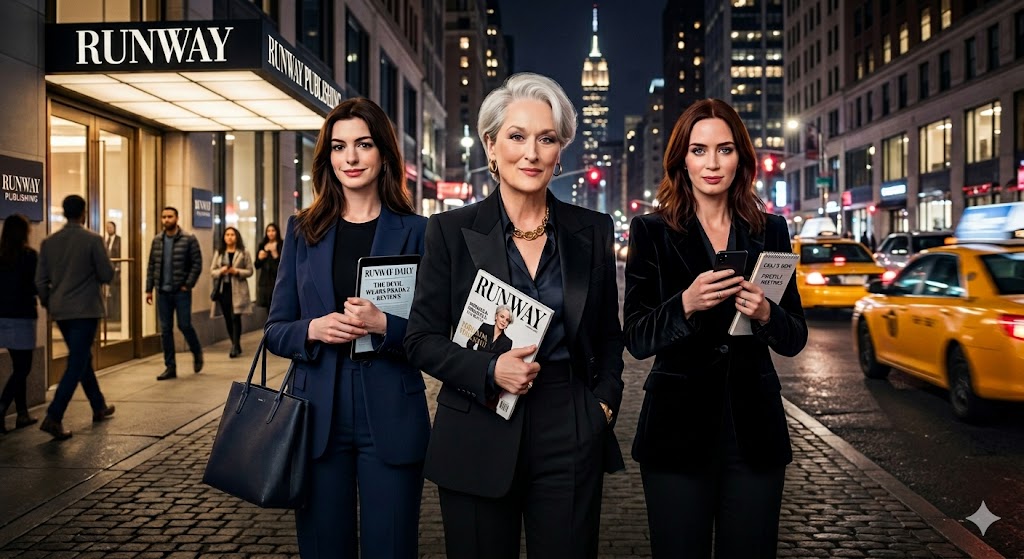
There are few cinematic experiences more deflating than watching a sequel to a beloved film and realizing, somewhere between the first and second act, that no one involved had the faintest idea why they were making it, other than to have a good time while cashing in. Such is the fate of The Devil Wears Prada 2, a picture packed with unexplored potential, yet so curiously inert that it seems to exist solely because its predecessor once did.
In the original The Devil Wears Prada, the title is not merely a bit of clever branding, it is the entire thesis, a warning, alerting us to the Faustian bargain within. “The Devil” signals temptation and descent. Anne Hathaway’s Andrea does not simply accept a job, she is offered a deal: career, access, status, in exchange for something far less visible and far more valuable. That is why the film hums with tension. It is not about fashion. It is Faust in couture.
And what makes the film unexpectedly wise is that its devil is not a monster. Meryl Streep’s Miranda Priestly is not evil in any comic book supervillain sense. She is something more unsettling: she is the consequence. She is what remains after the bargain has been honored in full, a woman who has not lost her soul so much as traded it, piece by piece, for the lies that the devil offers: the illusion of mastery, control, and success, and survival in a world that demanded nothing less. When Andrea sees Miranda broken by the news that her husband wants a divorce, stripped of her armor and makeup and exposed without the usual polish, she glimpses what lies behind the veil: not power, but emptiness. Miranda is not the devil tempting her anymore; she is the body the bargain leaves behind. So when Miranda, in the climactic scene, tells Andrea, “Everybody wants this,” Andrea finally understands the lie. Everybody may want the status, the access, and the illusion of importance. But it’s not worth becoming Miranda to get it. In that moment, Andrea chooses to reclaim her life.
And because we are dealing here with the devil, it is fitting that the antidote is biblical: the classic warning, “What does it profit a man,” or woman, “to gain the world and lose one’s soul?” (Mark 8:36). Christ asks the question rhetorically, but Andrea answers it anyway, and answers correctly.
But the sequel, inexplicably, dispenses with all of this. There is no temptation, no bargain, no descent, only vague professional errands dressed up as a plot. Andrea is no longer asked to choose between competing visions of herself. She is asked, at most, to be helpful here and there. The devil has not merely been softened, he has been written out of the story entirely, and what remains is a film that remembers the wardrobe but forgets the wager.
We are introduced, with astonishing lack of curiosity, to Andrea’s new social circle, an indistinguishable cluster of recently unemployed co-workers who drift in and out of a few pointless scenes (I think two) without names, purpose, or consequence. One of them, in a moment that briefly threatens to generate actual intrigue, suggests that Andrea write a tell-all exposé of Miranda. The idea lingers just long enough to remind you how much more interesting this movie could have been, then recedes as quickly as it arrived, only occasionally reappearing for a fleeting moment, as though the film itself recoiled from the notion of having a plot.
New York is the backdrop once again, but what was once a snarling, exhilarating beast — part opportunity, part menace — has been reduced to a series of antiseptic establishing shots and implausibly traffic-free car rides. The urban jungle has been declawed. The scenery is pretty, but New York is no longer a central character. The city is so diminished the movie might as well have been shot in Milwaukee.
Meanwhile, the film hastily reassembles its principal players as one would expect of one of these “let’s get the band back together” romps, mistaking proximity for purpose. Miranda glides through the proceedings as though she’s been shot up with elephant tranquilizers, her legendary hauteur replaced by a kind of resigned disengagement. She’s still in charge, but nobody fears her so much as she fears the HR department. Emily, once a deliciously venomous presence, is given no one to eviscerate and thus has nothing to do. Stanley Tucci, a man capable of elevating even the most threadbare material, is relegated to the narrative equivalent of a well-dressed coat rack. His Nigel doesn’t even need to be won over this time by Andrea, because they are already friends, which turns what was once a meaningful challenge into a foregone conclusion.
Andrea herself faces no real dilemma, makes no consequential decision, and emerges unchanged. It is a peculiar thing to watch a protagonist who appears to have been granted immunity from conflict. One keeps waiting for the moment when the film will demand something of her — some choice, some sacrifice, some cost — and it never arrives. She just very hurriedly arbitrates a manufactured dispute between Emily and Miranda in the third act, siding with the latter because… I’m still not sure why…. and that’s about it.
Perhaps sensing that the script needed something, anything, we are offered a fleeting romantic subplot between Andrea and a divorced building contractor of such negligible charisma and consequence that he seems to have randomly wandered in from an entirely different movie. Or maybe he actually was one of the film’s contractors, I don’t know. Perhaps he was finishing up work on the set when the cameras started rolling and they just decided to go with it. Whatever, he shares a handful of scenes with Hathaway, none of which justify his existence, and never manages to leave so much as a narrative footprint. The writers eventually solve the problem of his presence that they created themselves by the way, by almost immediately removing him from a birthday party he attends with Andrea, because even the film seems to realize he has no reason to be there. Or anywhere. It is the least necessary and least convincing romantic subplot since the Wicked sequel asked audiences to accept a love affair between a green lesbian witch and a gay scarecrow, who, between the two of them, managed to muster all the romantic passion of a zoning board meeting. Seriously, have some respect for the intelligence of the audience and the integrity of the story, such as it is.
But let us return to the most grievous offense, which is not the lack of romance, or humor, or even fashion — though all are conspicuously undernourished — but the absence of conflict. The film traffics almost exclusively in coincidence. Runway encounters a minor crisis that only Andrea can resolve; Andrea, naturally, is summoned; Nigel is already there; and, how convenient, Emily materializes in precisely the right place at precisely the right time, as though the universe itself were arranging a reunion special.
The problem is that drama does not arise from coincidence, it arises from collision. It’s lovely that all the actors seem so delighted to be working together again, but that bonhomie bleeds through into a movie that should be defined by sharp elbows, ambition, and the uneasy tension of an outsider caught in between.
Oh, the possibilities! The missed opportunities! The original deserved so much better. Consider how improved the plot would be had it involved something like Emily, now ascendant, running a rival publication. Miranda, still the reigning monarch, senses a threat. It’s youth versus experience, the new way versus the old, one coming for the throne and the other clinging to it. Andrea would stand between them, courted by both, trusted by neither. Now the past is not merely revisited, it is weaponized as loyalties are tested, and betrayals have consequences. Andrea is forced, at last, to choose, not between good and evil, but between competing visions of ambition, each exacting its own price. Now that would be a sequel!
What we have instead is a reunion, pleasant enough I suppose, intermittently diverting from a nap, and utterly devoid of necessity. It is the cinematic equivalent of opening an old photo album, a brief, nostalgic pleasure that fades the moment one remembers that the people in those pictures have already lived their stories.
One leaves the theater not offended, but confused, and with a single, inescapable question: why was this movie made at all, if it refused to consider what it could have been? The original understood that the devil was in the bargain. Here, the devil is nowhere to be found: not in the details, not in the drama, and certainly not wearing Prada.
You may also be interested in:
- The Surprisingly Christian Message of “The Ides of March” – Conservative Opinion
- Why Fashion Never Had a #MeToo Moment – Conservative Opinion
- The Office Spin-Off Is a Wall Street Fire Sale Disguised as Entertainment – Conservative Opinion
- Cabaret and the Moral Collapse of Weimar Germany Explained – Conservative Opinion
- Hollywood Phonies Fear AI Fakes – Conservative Opinion
- Righteous Indulgence: White Lotus and the Gospel of the Rich Liberal – Conservative Opinion