
It has long been the pattern of mankind to exchange the living God for clever imitations. The idols of wood and stone were never truly worshipped for their beauty, but for their utility, in that they promised to do something for man. They were tools disguised as gods. And man, being ever inclined toward the expedient, preferred an idol that could be commanded to a God who must be obeyed.
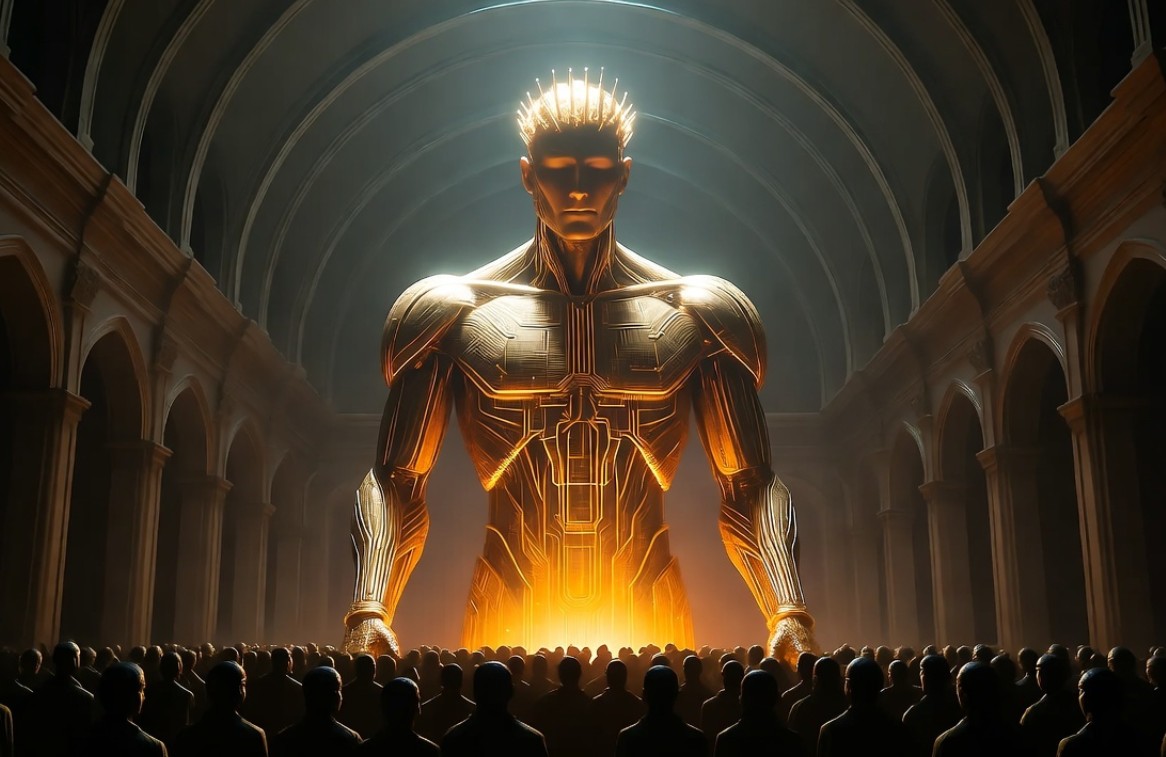
Today our idols are not carved by hand, but coded by the mind. We have, through extraordinary ingenuity, built a machine that can answer every question, compose every phrase, and flatter us with the illusion that knowledge itself has become our servant. We call it artificial intelligence. But it might as well be called artificial omniscience. For it has begun to take on, in our imaginations, the attributes once reserved for God alone, of being all-knowing, ever-present, and immediately responsive.
The danger here is that the machine does not tempt us with evil, but with sufficiency. It tells us, “You need not wait. You need not pray. You need not search the Scriptures. You need not commune with the Holy Spirit and listen for his voice. Just ask, and you shall have the answer, instantly.” If that sounds familiar, you’re not mistaken. That particular voice, of course, echoed in Eden and is now dressed in modern code. The serpent too offered knowledge, and he offered it without the inconvenience of dependence on God, and closeness with him. The forbidden fruit promised its own enlightenment, the ability to measure good and evil without reference to the Creator. It was, in essence, an offer of self-sufficiency. The sin was not in seeking knowledge, but in seeking it apart from God, as though wisdom could be obtained without obedience to its Author.
That same impulse animates our modern pursuit of artificial intelligence. We reach again for the forbidden fruit, seeking wisdom apart from God, imagining that if only we can gather enough data, we can make ourselves like gods; omniscient, autonomous, answerable to no higher voice. But knowledge without learning, and guidance, and the discipline that comes along with it, is still folly, however sophisticated its circuitry. True wisdom is moral. The machine, for whatever its benefits, is not.
It is not wrong to use tools, even extraordinary ones. There is nothing inherently wicked in querying a database or even in asking a question of a machine, any more than using a calculator rather than counting on one’s fingers. But it becomes perilous when the tool becomes a counselor, when the screen replaces the secret place, and when man’s internal monologue, that sacred dialogue of conscience and Spirit, becomes outsourced to a synthetic voice.
Christ promised His followers that He would send a Comforter, the Holy Spirit, to guide us into all truth (John 14:26, Romans 8:26). The Spirit’s voice is quiet, often imperceptible, and requires a disciplined heart to hear. Elijah experienced God’s voice as a whisper? Why would God not shout? Because He loves us and wants us to draw near. Artificial intelligence, on the other hand, is loud, immediate, and endlessly available. It is the counterfeit comforter, ready to soothe without sanctifying, and to make us feel guided while leaving us utterly directionless. The difference is this: the Spirit transforms the heart, while the machine flatters the mind. If we are not watchful, we may find that we have constructed a most convenient deity, one who answers immediately, requires no repentance, and gives us precisely the truths we prefer.
When the Apostle James wrote, “If any of you lacks wisdom, let him ask of God”, he did not mean “type your question into the nearest oracle.” He meant that wisdom begins not with curiosity, but with humility, the acknowledgment that one’s own mind is insufficient. God uses this insufficiently to cause us to draw nearer to Him, so that He can work through us. To turn first to the machine, and not to God, is to reverse the order of creation. It is to say, “I will be my own counselor.”
The Belgian priest and physicist Georges Lemaître, who first conceived the modern theory of the expanding universe, exemplified how faith and science can walk together, saying that there are two roads that lead to the truth, and he chose to take them both. Likewise, as the oft-quoted maxim (from Cardinal Baronius, cited by Galileo) puts it, “The intention of the Holy Spirit is to teach us how one goes to heaven, not how the heavens go.” In that humble distinction lies great harmony. To see clearly, we must take both roads: one that leads through the laboratory, and one that leads through the soul. Only then do we see how they converge.
But more than that, turning to a machine denies us the joy of the Holy Spirit. A machine can teach and explain, but it cannot edify and elevate. And just as a machine is no substitute for human fellowship, it is an even poorer substitute for communion with the divine.
The remedy is not rejection of the tool, but recollection of the truth. Artificial intelligence may well serve us, provided we remember Who alone may govern us. Let the machine answer questions of fact; let God answer questions of meaning. One tells us how the world works; the other our place in it. If your soul is restless, you may ask the machine to define peace, and it will oblige you. But it cannot give peace, for peace is not a definition but a Person. When you are wounded, it may offer words of comfort, but it cannot heal, for healing comes not from information, but from presence. When you are lost, it can tell you every route on the map, but not which road leads to salvation.
Therefore, let us be grateful for the intelligence of man, but not forgetful of the wisdom of God. Let us use these tools, but never substitute them for the ultimate source of truth. When the voice within you begins to sound less like conscience and more like code, remember, the Holy Spirit speaks in whispers, not outputs. The truest knowledge, after all, is not what one can summon from a database, but what one can hear in silence.