
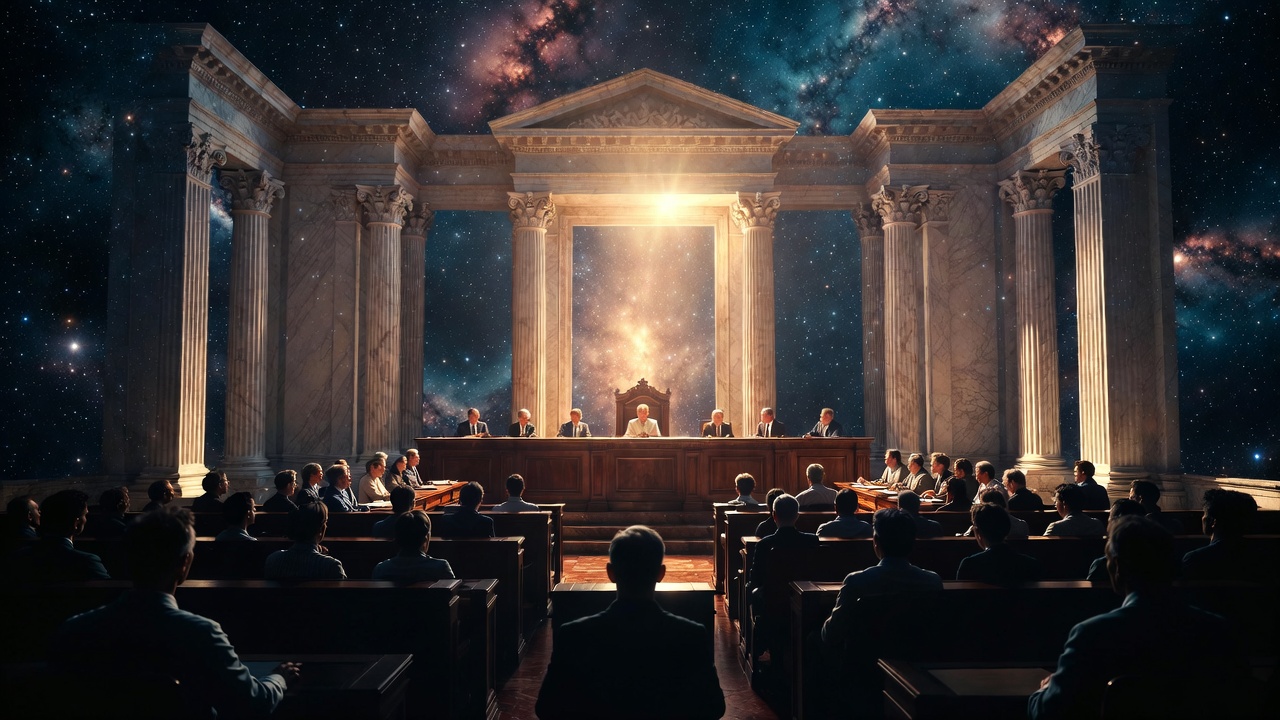
Part I: The Anatomy of a Verdict
Everyone enjoys a good murder mystery, so see if you can solve this one.
My first job as an attorney was as a prosecutor in Middlesex County, New Jersey, and in 2007 the most prominent case in the county was State v. Melanie McGuire. It actually gained national recognition as “the suitcase murder,” because the body of McGuire’s husband had washed ashore in the Chesapeake Bay in three separate suitcases. CourtTV provided coverage, and McGuire was represented by a high-profile attorney named Joe Tacopina, who also represented baseball star Alex Rodriguez, as well as the defendant in the Natalee Holloway murder, amongst others.
Why did law enforcement suspect McGuire was her husband’s murderer? For one thing, she was the last person known to have seen her husband alive. And that, of course, proves… absolutely nothing. Plenty of innocent people are last seen with loved ones who later die.
There were also rumors of an affair. That proves nothing either; infidelity is common, murder is not.
OK, true, but Melanie’s husband had been shot, and Melanie owned a gun. But many people own guns.
Yes, but the bullets that killed her husband were of the same caliber as Melanie’s firearm. Fine, but it was a .38, which is an extremely common caliber. Coincidence is always possible.
Fair enough. I suppose it was also a coincidence that she had purchased the gun just two days before her husband went missing. Yes, that was troubling, but still not conclusive. And she lied about it to police. Conduct inconsistent with innocence, sure, but maybe she was just scared.
And the trash bags in which the body was wrapped matched those found in her home. And the towels found in the suitcases soaked in blood were identical to those from the OB-GYN clinic where she worked, and these were specialized medical towels, not household ones.
And it just so happened that she had purchased three suitcases shortly before her husband’s disappearance, the same type later found containing his remains, and when questioned by law enforcement she could not locate them.
None of this, standing alone, proved anything.
It also didn’t help Melanie’s cause that shortly before her husband went missing, there were internet searches traced to her computer for such phrases as “undetectable poisons,” and “how to commit murder.” Again, suspicious, but not dispositive.
Add to all of that an episode that would be laughable if it were not so incriminating. While awaiting trial, the Attorney General’s office received a FedEx box filled with random household items and a note claiming that Melanie McGuire was innocent and that the true culprit could be identified by following the “clues” inside. Investigators traced the package to the FedEx store, reviewed the surveillance footage, and, lo and behold, who do you think was on camera mailing the package? Yes, Melanie McGuire.
At trial, McGuire’s attorneys presented evidence pointing the other way. There was no blood found in her home or in the hotel room she had rented. And she was a small woman, barely over one hundred pounds. The defense argued that it strained belief that she could have killed her husband, dismembered him, left no forensic trace, transported three heavy suitcases, and disposed of them at sea.
The issue before the jury, as with all juries, was not whether any single fact proved guilt with scientific certainty, but whether innocence remained a reasonable explanation once all the evidence was considered together. It did not. Melanie McGuire was convicted beyond a reasonable doubt. Of course she was!
And notice this: no faith was involved in that verdict. No leap into the dark. No suspension of reason. No superstition. The jurors did exactly what rational people do every day: they evaluated cumulative evidence, and adopted the explanation that best accounted for the whole.
Now imagine a juror who approached the case the way atheists approach the question of God. First, they would demand the case be proven with scientific certainty, rather than the usual standard of beyond a reasonable doubt. Nobody would ever be convicted of anything.
Such a juror would also dismiss each piece of evidence in isolation. The gun proves nothing. The suitcases prove nothing. The internet searches prove nothing. The towels prove nothing. And having dismissed each item individually rather than consider them as parts of a larger story, he would conclude that there was no reason to believe McGuire’s guilt.
In fact, such a juror would not even refer to the evidence as “evidence.” He would say there was “no evidence” that Melanie McGuire killed her husband, because that is precisely what is said, over and over again, about God. Listen to the familiar refrain from public figures like Brian Cox, Neil deGrasse Tyson, or Richard Dawkins, each of whom have dismissively stated that there is no evidence at all for God; or the late Christopher Hitchens, who said of God, with great self-satisfaction, that “anything that can be asserted without evidence can be dismissed without evidence.”
This, dear reader, demonstrates perhaps the most obvious and important defect in the atheist mind, that they do not even know what the word “evidence“ actually means, much less how to weigh it, or that it even requires weighing.
Evidence is not the same thing as conclusive proof with scientific certainty. Evidence is simply anything that tends to make one proposition more likely than another. Fingerprints are evidence. Motive is evidence. Opportunity is evidence. Eyewitness testimony is evidence. The appearance of a plan, or a scheme, or a design is evidence. None of these things are infallible; all of them are contestable. Scientific certainties are great, but they are rare. Courts exist precisely because evidence must be tested, weighed, and sometimes rejected. To fail to draw logical inferences from independent pieces of evidence, or worse, to say that disputed evidence is therefore not evidence simply because it does not, by itself, prove its case with scientific certainty, would be to make the entire legal system unintelligible.
If something appears designed, that appearance is evidence—perhaps weak, perhaps strong, but evidence nonetheless—that it may have had a designer. That is true of a machine, an organism, or a universe. If people claim to have witnessed the ministry of Christ and His resurrection, that claim constitutes eyewitness testimony. It may be unreliable. It may be false. It may ultimately fail to persuade. But it is still evidence of the very sort we evaluate in courts every day.
One is perfectly entitled to argue that the evidence for God is unconvincing. One is not entitled to pretend that there is no evidence.
At this point, the confusion becomes clear. The mistake is a category error, treating “not proven to scientific certainty” as though it were the same thing as “no evidence whatsoever.” Once that error is exposed, the debate changes shape entirely. The question is no longer whether there is any evidence for God, but whether the cumulative weight of the evidence points more reasonably in one direction than another. That is how rational judgments are made in courtrooms, in history, and in ordinary life.
And none of it requires faith.
Part II: Faith After the Verdict
At this point, something important must be clarified, because the word “faith” is doing far too much mischief in modern conversation.
Faith is commonly treated as though it were a substitute for evidence, as if believing in God requires one to suspend reason, ignore facts, and leap bravely into the dark. But this is not how belief actually works, nor is it how Christianity has ever understood itself. The confusion arises from treating belief and faith as though they were the same thing.
Belief, properly speaking, is a conclusion. It is what happens when evidence is weighed and found sufficient. We believe the earth is round, not because we have personally circumnavigated it, but because the cumulative testimony of observation, science, and history points unmistakably in that direction. We believe Julius Caesar existed, not because we have met him, but because the alternative explanation—that the evidence coherently assembled itself by accident, or that it’s part of some broad conspiracy thousands of years in the making—is far less reasonable. In such cases, belief is not a moral virtue or a spiritual leap, it is simply the brain doing what the brain is meant to do.
Belief in God, when honestly approached, belongs in precisely this category. The order of the universe, the fine-tuning of physical laws, the extreme appearance of design, the language of DNA, the persistence of moral obligation, the historical particularity of Christ, the credibility of those who swore by it and died for it, and the strange human longing for meaning that transcends survival, all converge on a single conclusion far more plausibly than any alternative. One may argue about individual pieces of evidence, just as one may quibble over individual facts in a court case, but at some point the question ceases to be whether any doubt remains and becomes whether disbelief is still reasonable. To say that belief in God requires “faith” in the sense of believing without evidence is therefore a mistake. It is not faith at all. It is judgment.
An atheist often asks “How do you know God exists?” We don’t. Just as we do not know that Melanie McGuire killed her husband. If you want to get particularly philosophical about it, we don’t even know that Melanie exists, since the observer could simply be hallucinating. But just as we can believe that she does exist and is guilty because the evidence weighs toward that conclusion, so can we believe in God for the same reason.
Where faith truly enters is not in deciding whether God exists, but in deciding whether we can trust Him: that, for example, He is benevolent, that we were made with divine purpose, in His image, and that his plans for us are for our good and not for harm.
This is a subtler and far more demanding matter. Once a verdict has been reached, something else must follow. In a courtroom, belief that a defendant is guilty carries consequences. The court does not merely nod and move on; it must assent to the judgment and allow it to shape action. In much the same way, belief in God, once established, presses forward into a second and more uncomfortable question: If this God exists, and if He is as He claims to be, am I willing to trust Him more than I trust myself?
This is where faith becomes costly. Faith is not believing that God is real; it is believing that God is good even when circumstances obscure that goodness. It is trusting that an all-knowing mind sees connections we cannot, purposes we would not choose, and ends we would not design. It is choosing obedience when autonomy looks safer, restraint when indulgence seems harmless, and hope when experience urges despair. Faith is not a failure of reason; it is reason’s decision to relinquish absolute control.
This is the distinction atheists like Alex O’Connor fail to make, when he admits that his atheism is sustained by evidence of, for example, pointless deaths that God could prevent. Here he conflates two things: he sees God as not being all good, therefore he concludes that He does not exist. This is forehead-smacking non sequitur at its finest, and yet it often goes unchallenged.
This failure of distinction helps explain why the debate between atheism and theism is so often mischaracterized. It is commonly framed as a contest between reason and faith, between evidence and superstition. In reality, both sides appeal to evidence. The disagreement lies not in whether evidence exists, but in how much weight it is allowed to carry and what conclusions one is willing to live with once it has been weighed. Faith does not begin where evidence ends; it begins where trust becomes necessary.
Christianity, then, does not ask a man to stop thinking. It asks him to start thinking critically, and having done so, to then recognize that thinking does not entitle him to remain sovereign. One cannot dismiss the evidence simply because one does not like where it leads.
In that sense, faith is not the opposite of reason. It is the courage to follow reason all the way to its end, and then to live as though the conclusion matters.
Part III: Science, Reason, and the Burden of Proof
I once heard an atheist say that he does not believe in God because he does not believe in anything that he cannot fit into a test tube. What a silly comment. The demand for test-tube certainty is not a mark of rigor; it is a misunderstanding of how human knowledge actually functions. The scientist who claims to believe only what can be experimentally verified is therefore not displaying intellectual discipline, but intellectual narrowness. His field of vision is sharply focused, but narrowly framed. He has confused a powerful method with a complete philosophy, and in doing so has turned science from something liberating into something profoundly limiting.
Very few of the things we believe most firmly are proven with scientific precision. Courts rarely operate with scientific certainty. History does not. Neither does ordinary life. We make countless decisions every day without laboratory proof. We trust friends, marry spouses, raise children, make moral judgments, step out into a potentially dangerous world, and render verdicts, all without scientific confirmation. If we were limited in our thinking and our actions to only what we could confirm experimentally, we would scarcely be able to believe—or do—anything at all.
We can know that God either does, or does not exist, but neither fits inside a tube, anymore so than Melanie McGuire did. Scientific methods cannot be applied to God because God, if He exists, must exist outside the universe He created, just as a software designer does not reside inside the code he writes. The programmer may interact with the program, manipulate it, and even immerse himself in limited ways, and we can see evidence of his design, but he is not contained by it.
In the same way, God’s handiwork may be found within the universe. His logic may be traced in its laws. His architecture may be discerned in its design. Evidence of Him may be everywhere. But God Himself will not be sitting inside the cosmos waiting to be weighed and measured like a chemical compound. The problem, then, is not that science disproves God, but that science is insufficient for understanding Him, just as it is insufficient for understanding most of the great decisions we make.
That is where reason enters.
A fair application of reason, informed by the various classical proofs for God’s existence—design, contingency, moral obligation, and human experience—points not merely to the possibility of a Creator, but to the probability of one. Taken together, the evidence forms a cumulative case. Not a mathematical demonstration (although, there is some evidence for that), but something far more common and far more human: a conclusion reached by weighing the whole.
One could, I suppose, end the essay there, but considering we opened with a legal example, I would be remiss if we did not address who, in this debate, actually bears the burden of proof.
In criminal law, the burden is high. The prosecution must prove guilt beyond a reasonable doubt because the cost of error is grave. We do not wish to condemn the innocent. In civil cases, the burden is lower. The question is simply which explanation is more likely than not.
Now consider the stakes in the God question.
If a man believes wrongly that God exists, and orders his life accordingly, what is the cost if he turns out to be mistaken? He dies, as all men do. If, however, a man believes wrongly that God does not exist, and structures his life around that belief, the cost—if he is mistaken—is infinitely higher, and certainly much worse than jail.
In that sense, the burden does not rest on the theist. It rests on the atheist, the side which prosecutes God. To deny God safely, one must be able to say with confidence not merely that the evidence is inconclusive, but that God does not exist beyond a reasonable doubt. That is an extraordinarily strong claim, and one that is nearly impossible to support. It is far easier to dismiss everything as mere coincidence or simply unconvincing, just as the defense attempted to do in the McGuire case. But dismissing something is not the same as explaining it.
There is abundant evidence suggesting that God exists. There is almost none that positively demonstrates His absence. Atheism does not have science on its side. It merely demands the impossible of the other side, which is to prove its case with scientific certainty, even though the burden is its own.
A final word before we conclude. Notice, reader, that I have not attempted here to catalogue the specific evidences for God’s existence in detail. Others have done that work, and it’s easy enough to find. But there is one form of evidence that no Christian should ever neglect, and which no atheist can easily dismiss: not an argument, not a syllogism, but the unmistakable evidence of a transformed life.
Christianity ultimately makes a testable claim, not in a laboratory, but in the human soul. Christ in you, as Scripture puts it, produces something recognizable. A change of loves. A reordered will. A new posture toward suffering, forgiveness, and truth. Arguments may clear the ground. Evidence may point the way. But it is this lived reality that often proves the most persuasive of all.
And perhaps that is fitting. For the God who can be reasoned toward is also the God who must be trusted, and trust, as we have seen, begins only after the verdict has been reached.
Modern culture often flatters itself as uniquely rational, yet it routinely demands a kind of certainty that human beings have never possessed and could not live by if they did. We insist on laboratory proof where none is possible, dismiss evidence because it is not absolute, and confuse intellectual caution with wisdom. In doing so, we do not elevate reason, we impoverish it. Reason was never meant to answer every question by itself, but to carry us as far as it can and then invite us to respond honestly to what it has shown. When reason is allowed to do its full work, it does not end in superstition or despair, but in recognition: recognition that the universe is not self-explanatory, that meaning is not accidental, and that trust is not the enemy of thought but its natural successor.
Long before modern debates about science and faith, Scripture assumed precisely this posture: that what can be known has been made plain, that reasons can and should be given, and that the real question is not whether light exists, but whether we are willing to walk by it. Faith, in that sense, is not blindness. It is obedience to sight.