

Fascism was not a contradiction of Weimar decadence. It was its consequence.
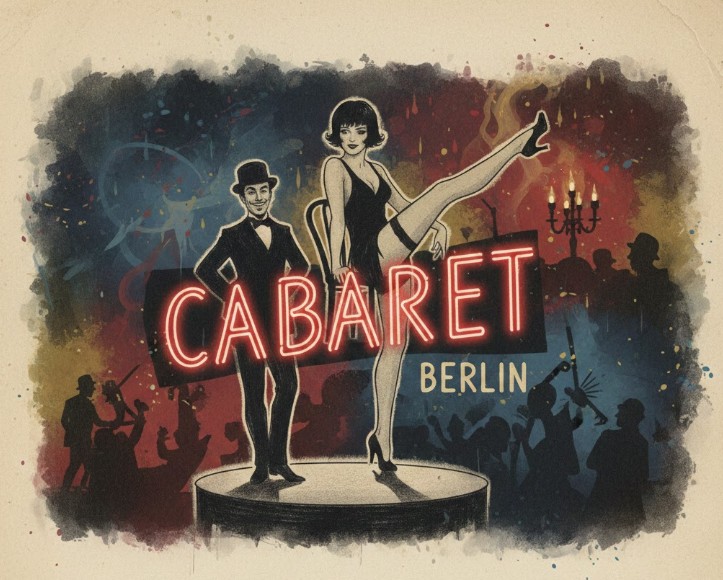
It is easy, perhaps too easy, to be dazzled by Cabaret. The music is infectious, the performances electric, the decadence deliciously theatrical. Set in a Berlin nightclub during the waning days of the Weimar Republic, the musical offers a glittering portrait of a culture dancing on the edge of collapse. It presents itself as a cautionary tale: a free-spirited, sexually liberated bohemia tragically overrun by jackboots and swastikas. The moral, we’re told, is clear: look what happens when the fascists take over.
But Cabaret makes a very deep, and very revealing mistake. It contrasts the nightclub and the Reich, the libertine and the authoritarian, as if the two were opposites. It never quite looks itself in the mirror and asks the more disturbing question: what if both of these things are happening for the same reason? Or worse, one is opening the door for the other?
Because the party didn’t just precede the collapse. The party was the collapse. The Kit Kat Club, with its sexual freedom, blurred identities, and rejection of moral constraint, isn’t the brave last gasp of a vibrant culture. It’s the spiritual exhaustion that made the culture vulnerable in the first place. What Cabaret celebrates as freedom was in fact a rejection of godliness, moderation, and self-control. And that doesn’t make a society more free or rational or just; it makes it decadent and vulnerable.
Evil is not stupid. It is clever. It is insidious. It does not announce itself with a pitchfork and horns. It doesn’t come at you with a hammer or handcuffs or firing squads. That would never sell. No, evil comes at you with a good time. It comes with charm and color and music. It offers freedom, sensuality, pleasure, and a feeling of moral or intellectual superiority. It tells you to throw off restraint in favor of self-indulgence. To throw off modesty in favor of licentiousness. To throw off moderation in favor of excess. And it flatters you by telling you that you’re smarter, more enlightened, more evolved than those who still cling to restraint and old traditions.
No one abandons God in favor of fascism or decay. They abandon Him in favor of pleasure, of self-indulgence, of novelty, of intellectual stimulation. Those are the delivery devices, the gateway drugs. The slow poison. By the time the consequences arrive — broken homes, fractured souls, dehumanized systems — the decay has already taken root. And when those things break, the strong men arrive, not as invaders, but as rescuers. The evil that follows is only the final symptom of a sickness long ignored.
So we must understand this godlessness not just as absence, but as temptation, a seduction. The moral collapse of Weimar Berlin wasn’t driven by evil men in uniforms. It was driven by a society that stopped seeking God and started chasing its own desires. Some followed the flesh, abandoning chastity and modesty for spectacle, novelty, and eroticism. Others followed the mind, turning to cleverness, theory, and political abstraction, finding self-gratification not in the wisdom of the Gospels, but in the nihilism of Nietzsche and Marx, and the racialism of social Darwinism. But both paths led away from reverence, of God and of each other, and to something much darker.
Just as John the Baptist went ahead of Jesus to prepare the way for Him, unrestrained self-indulgence, whether in the form of hedonistic sex or secular intellectualism, prepared the way for the evil that followed. It cleared the altar of God and left it bare.
Far fetched? Then consider the moment in Cabaret that quietly reveals the depth of this moral drift: Sally’s decision to have an abortion, almost offhandedly, as if it were just another inconvenience to be managed. It isn’t dwelled on, and that’s precisely the problem. In a world where sex is casual and people are disposable, so too is life itself.
That Cabaret can’t see this obvious connection — between Sally casually disposing of life, and that same indifference in the oppressors — is so lacking in self-awareness as to be unnerving. The film ends in the cabaret itself — dark, filthy, and dingy — and it occurs to no one that this society has gleefully traded light for darkness, beauty for garishness, art for ribaldry, and love for low-grade encounters. It is a dead culture, that wonders why it now faces a death culture. It’s a loveless culture, that wonders why it now faces a hate culture.
This wasn’t, of course, unique to Cabaret. It reflected broader cultural currents in Weimar Germany, where Darwinian eugenics was gaining intellectual traction and moral seriousness was giving way to utopianism. But can you not see the parallel here? The connective tissue? The idea that some lives were more desirable than others, or that the future could be engineered by discarding the inconvenient, was already at work. The seeds of dehumanization don’t begin with hate. They begin with indifference and ideas divorced from godliness.
Sexual liberation and secular intellectual arrogance are not themselves fascism, but here they created the conditions that allowed for it, and invited it. A sexually liberated people see others, and even themselves, as interchangeable, and therefore disposable. Have a partner one day, discard him the next. Make a baby one day, discard her the next. And the secular intellectual, for his part, sees not each man created equally in the image of God, but rather the things that make us unequal. He sees not individual rights, but how the rights of individuals can work against the group as a whole.
This here, promiscuity decaying morals to the point that people are disposable, combined with a learned class that rejects equality and individual rights in the name of science, these are the ingredients of tyranny. How could it not follow?
That’s the real tragedy beneath Cabaret: not just that fascism came, but that it was invited.
Of course sexual liberation does not always lead to tyranny, and tyranny often comes from conditions that have nothing to do with sexual liberation. But it is not harmless. It leaves in its wake broken families, wounded individuals, and a generation increasingly incapable of forming deep, lasting relationships. It teaches us to indulge the self at the expense of the other, reducing people to instruments of gratification rather than subjects of love. The more partners we cycle through, the more disposable they become, and the harder it is to see anyone as irreplaceable.
That’s why cultures, across time and place, have created moral frameworks and social stigmas around sex, not to suppress joy, but to protect it. Not to deny people pleasure, but to anchor it in meaning. Restraint is not repression; it’s cultivation. Without it, we don’t build, we consume. And what we consume does not last.
Let’s not flatter ourselves that we’re wiser. Today we’ve outdone Weimar: porn on demand, an entire movie industry that sells violence and sex (and violent sex), children raised without fathers, schools that deconstruct identity instead of shaping character, churches that apologize for their own existence. And we call it freedom. We congratulate ourselves for being more tolerant, more expressive, more “authentic,” all while we medicate our despair and drown in distraction.
No, fascism isn’t at our door. But the family court is. The fentanyl is. The mental illness is. The brokenness is. The violence is. And the loneliness is.
But back to Cabaret, where God was not rejected in favor of fascism, but rather in favor of pleasure and pride. First came the lure of sexual indulgence, and the intoxication of intellectual superiority. Together, they promised liberation from constraint, both moral and intellectual. But in casting off those constraints, society lost the very things that shield it from evil. What followed wasn’t a surprise, it was an inevitability. Fascism didn’t invade a healthy culture; it stepped into the space left behind. It offered moral justification — gratify the self at the expense of others — and intellectual legitimacy — engineer a perfect society through centralized population control. And because the soul was already hollowed out, evil was welcomed when the economy collapsed.
That’s the devil’s trick: not to storm the gates, but to get you to open them yourself. He doesn’t overtake with force, he gets you to welcome him in. He creates the problem, then presents himself as the solution.
The tragedy of Cabaret is not just what it shows. It’s what it fails to see: that the dancers and the tyrants, the party and the purge, are not enemies. They are siblings, born of the same abandonment of God, of order, of truth.
You may also be interested in:
- Why Hitler Hated Christianity, But Not Atheism – Conservative Opinion
- A Conservative’s Overture to the Arts Community – Conservative Opinion
- The Laughter of a Lost Civilization – Conservative Opinion
- The Surprisingly Christian Message of “The Ides of March” – Conservative Opinion
- The Oscars: Where #MeToo Hypocrisy Wins Best Picture – Conservative Opinion