

Unless you’ve read the Bible cover to cover, you probably haven’t bothered to read the Book of Obadiah. Why would you? One of the “minor prophets,” Obadiah contains no inspiring poetry like Psalms, no heroes like Genesis, no parables like the Gospels, and none the vibrant theology of Paul. In fact, the book is so short that it does not even have chapters.
But in its few verses can be found, in miniature, one of the great warnings of political history, and one that is especially apropos to modern America. It is directed against a nation descended from Esau known as Edom, whose people lived high in the mountains, where they felt secure and beyond the reach of calamity. It was from this lofty perch that they saw their neighbor Judah being attacked in the valley below, exposed and vulnerable, and this brought a strange comfort to the Edomites because it confirmed their belief that they were themselves safe. Edom responded not with sobriety or mercy, but with the smug detachment of a people who believed themselves beyond the reach of history. Their security, in turn, became arrogance, and, feeling free from consequence, they became a decadent people, turning their backs on wisdom and righteousness in favor of the habits that so often accompany comfort and ease. This lack of vigilance, this abandonment of principle, this pride, led to their destruction, as it always does.
In Edom we see a particular form of stupidity that tends to afflict powerful nations, made all the more dangerous by the fact that it rarely feels like stupidity at all. It feels rather like confidence and stability, like the mature self-assurance of a people who have grown accustomed to thinking of their dominance as the natural order of things and therefore permanent, rather than an inheritance to be guarded.
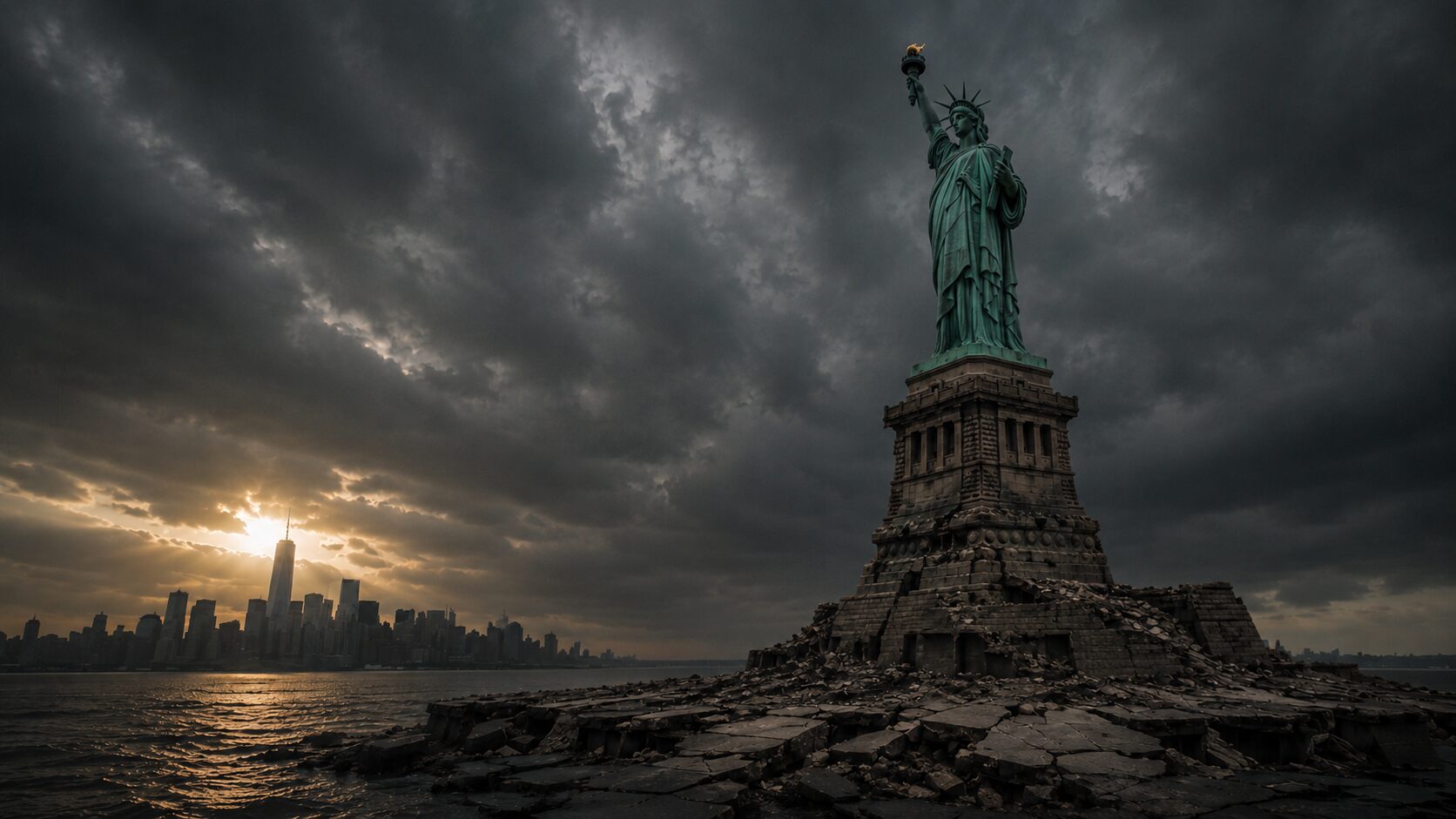
America has constructed its own version of this conceit, though ours is adorned with the grander furnishings of modernity. We are protected, we tell ourselves, by two vast oceans, by immense wealth, by technological superiority, by military force on a scale no empire in history could have imagined, by constitutional continuity, by economic centrality, by the accumulated prestige of being America. We speak of these things as if they were iron laws of nature rather than temporary conditions in human history. We take what has been achieved, or inherited, and quietly begin treating it as something metaphysically guaranteed. Our prosperity becomes proof of our permanence, and our power becomes evidence of our virtue. Our sheer size and sophistication become, in the national mind, a substitute for the old and humbling recognition that every nation is made of crooked timber and subject to rot, crumble, or burn.
What makes this delusion so seductive is that it is not wholly irrational. Edom really did have mountains. America really does have oceans, money, weapons, and astonishing capacities. The problem is not that these things are unreal, but rather that nations routinely mistake real advantages for ultimate protection. They confuse the possession of defenses with exemption from decline. They assume that because they remain formidable from without, they must therefore still be sound within. But history offers no warrant for this assumption. On the contrary, history is in large part the record of powers that continued to look impressive on the outside even as decay was already at work behind the walls. A nation does not need to be conquered before it begins to collapse. It need only become decadent, arrogant, frivolous, and morally exhausted.
And here one must insist upon a truth that our age, with its vulgar materialism and infantile politics, does not like to hear. The ultimate security of a people is not merely a matter of gross domestic product, missile defense, or favorable geography. These things may preserve a state for a time, just as a handsome façade may preserve the illusion that a rotten house is still habitable. But no society can remain strong when it has lost the moral habits on which strength depends. A nation that cannot govern its appetites, that mistakes self-indulgence for freedom, that sneers at discipline, that dismantles the family, that cheapens religion without replacing it with anything but pharmaceuticals, therapy, and cheap amusement, that trains its citizens to think only in terms of grievance and entitlement, is not a strong nation merely because it is rich. Nor is it rich simply because it can borrow vast sums. It is a vulnerable nation enjoying borrowed time, borrowed money, and a false sense of security.
This is the great error of decadent civilizations: they imagine that collapse can only arrive with trumpets and banners, with foreign armies massed dramatically at the gates, with some unmistakable cinematic signal that the end has begun. In reality, decline is usually more gradual and subtle than sudden, more humiliating than dramatic. It announces itself first in degraded tastes, in collapsing seriousness, in the inability of a people to distinguish liberty from license. It appears in institutions that no longer command respect because they no longer deserve it, in elites who confuse cleverness with wisdom, in a public culture so saturated with narcissism and spectacle that the very notion of righteousness begins to seem quaint or oppressive. By the time the external shocks arrive, the real work of destruction has often already been done.
That is why the lesson of Obadiah remains so unnervingly modern. One need not even begin from theology to see its force, though theology explains it best. The central insight is plain enough, that nations that imagine themselves above consequence are nations already in peril. A people that has become too impressed by its own architecture of power soon forgets the simpler question of whether it remains worth preserving. And that is the question advanced societies almost never ask themselves, because it is easier to count assets than to examine souls. It is easier to point to stock indexes, aircraft carriers, data centers, and election rituals than to ask whether the people who preside over such things are still capable of courage, restraint, reverence, gratitude, and self-command. Yet those old-fashioned virtues, which modern man finds so embarrassing, are closer to the foundation of national endurance than any number of technological marvels.
We flatter ourselves, of course, that democracy by itself is a kind of magic shield, as if the mere holding of elections were enough to preserve a people from corruption, folly, or ruin. But democratic forms are no more self-sustaining than mountain fortresses. A republic requires a certain quality of citizen, and that quality does not emerge automatically from abundance. It must be cultivated, disciplined, handed down, reinforced by institutions and customs that teach human beings they are not the center of the universe, and neither are they accidental, but rather beings made purposefully in the image of God, worthy of mutual love and respect. Once that moral ecology breaks down, democracy itself becomes only another instrument for appetite, another means by which factions loot the future and flatter the present. What is called self-government becomes, in effect, collective self-indulgence; what is supposed to be a guarantor of freedom becomes instead a mechanism to rule over others. And no nation, however procedurally sophisticated, can long survive that transformation.
It is therefore not alarmism, but realism, to say that America is far more vulnerable than it imagines. Our enemies are real and aligning against us, but the greater threat lies in the national habit of assuming that our external advantages can indefinitely compensate for our internal disintegration. They cannot. Wealth cannot indefinitely redeem cultural rot. Military power cannot indefinitely defend a nation that no longer believes it is worth defending. Technology cannot restore a moral vocabulary that has been deliberately dismantled. And political slogans cannot revive a civilization that has come to prefer comfort to character. A nation may survive invasions, depressions, scandals, and even wars. What it does not survive, at least not for long, is the loss of the virtues that made its survival possible in the first place.
Obadiah’s lesson for America is not obscure. If anything, it is almost embarrassingly plain. A nation may sit high for a time and still be near its ruin. It may possess strength and yet already be weak. It may congratulate itself on its security while the moral terms of its survival are being quietly abolished. The Edomites believed their position made them untouchable. Americans increasingly believe the same thing for more sophisticated reasons, which is merely to say that we have found more elaborate words for the oldest human delusion. We think our wealth will save us, our weapons will save us, our systems will save us, our intelligence will save us, our reputation will save us. Things will always work out for us in the end. No, they will not. If righteousness no longer governs us, then all our grandeur is only scenery, and all our confidence is only the prelude to a fall.
You may also be interested in:
- C.S. Lewis Warning for America: A Call to Reflection – Conservative Opinion
- The Laughter of a Lost Civilization – Conservative Opinion
- The Enemy Is Us: Facing Our Complicity in Violence – Conservative Opinion
- A Great Civilization is a Merciful Civilization – Conservative Opinion
- In Defense of Modesty: The Forgotten Pillar of Progress – Conservative Opinion
- Why Bonhoeffer Matters – Conservative Opinion