

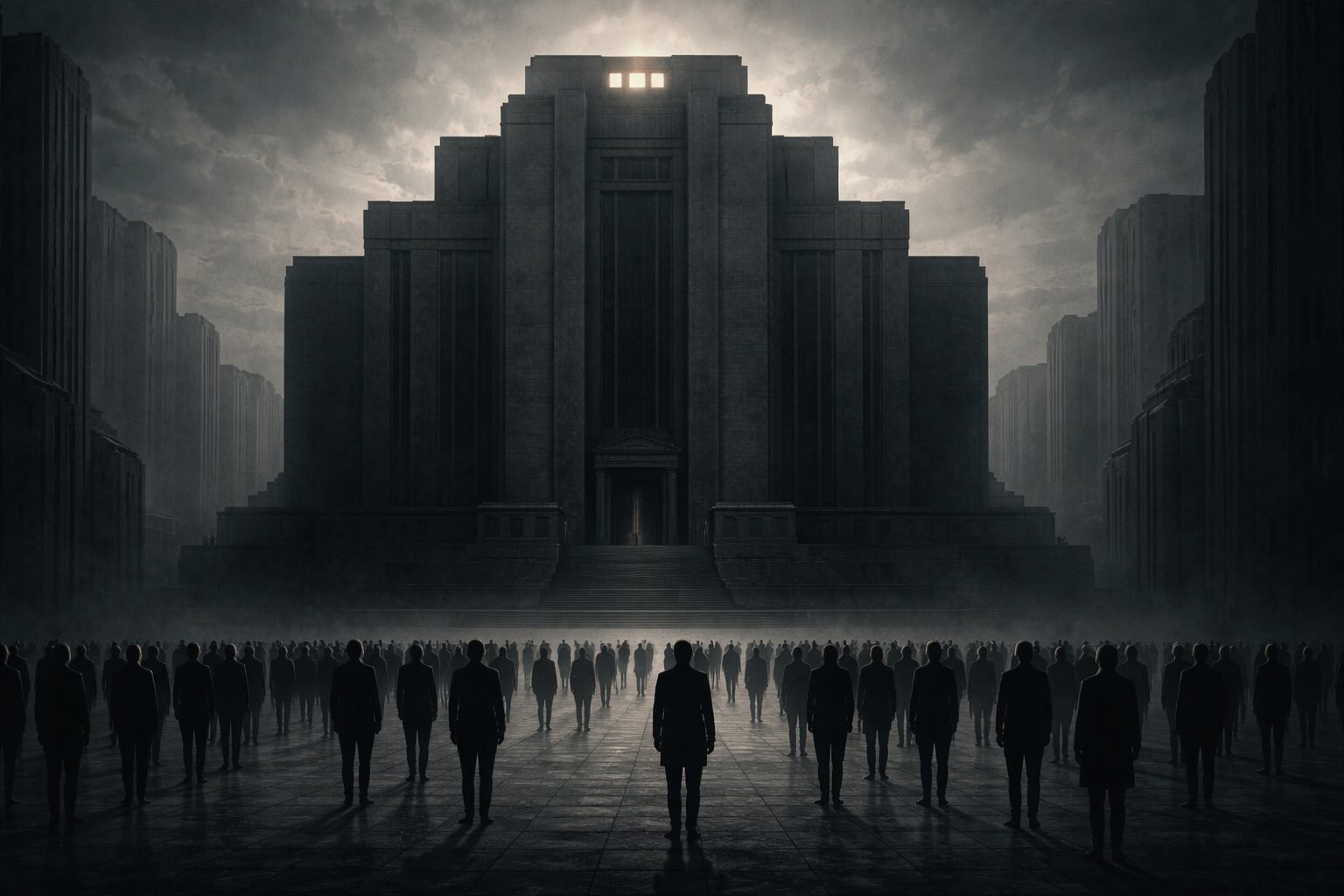
One of the more durable falsehoods in modern political discourse is the reflexive classification of fascism as a “right-wing” ideology. It is repeated so often, and with such breezy confidence, that few pause to examine whether it makes even rudimentary sense. Yet upon inspection, the claim collapses. Not because fascism is benign, misunderstood, or somehow redeemable, but because it bears almost no resemblance to what the Right, properly understood, has historically meant.
The political spectrum, stripped of mythology and academic fog, is easily defined. Moving left leads toward more government; moving right toward less government. Travel far enough in one direction and the state expands until it absorbs everything. Travel far enough in the other and the state recedes until it disappears altogether. Totalitarianism lies at one end of this spectrum; anarchy at the other. These are not interchangeable destinations. One does not travel down the road of decreasing government and somehow arrive at total government, any more than demanding more and more government leads to no government at all. This is not an argument about ideology. It is simply geometry.
The political Right, in its Anglo-American tradition, is defined by skepticism and disdain of state power, and an emphasis on liberty. It insists on small, limited government, the supremacy of the people over the state, and rights that exist prior to and independent of political authority. Conservatism is not utopian. It does not imagine human beings perfected by policy. It does not seek power over the population to reshape society in its image. It is born, rather, of a desire not to be ruled, it romanticizes individualism and individual liberty, and, ever cognizant of what happens when power goes unchecked, it demands that power not be concentrated among the few in government, but dispersed among the people.
To label fascism as “right-wing,” then, is to deliberately misrepresent what the Right stands for in the first place, in order to shift blame. It assigns the gravest crimes of centralized state power to the very tradition that arose to oppose such concentrations. Fascism is the apotheosis of the state. It is government without limit, authority without restraint, power without appeal. It is not an experiment in decentralization. It does not arise from an excess of liberty but from its eradication. It does not elevate the individual, protect private conscience, or restrain the ambitions of those in power. Quite the opposite. Fascism is a totalitarian creed, animated by the belief that the state is supreme over all competing institutions, loyalties, and rights. It seeks not merely obedience, but submission. Speech, religion, commerce, education, family life, and even thought itself are brought under centralized control. The individual exists only insofar as he serves the collective, and the collective exists only insofar as it serves the state.
If this is “right-wing,” then words have lost all meaning.
The academic taxonomy that placed fascism on the “right” did not arise from clear thinking, but from narrative necessity. After the Second World War, fascism was morally radioactive. Collectivism, however, remained intellectually fashionable among those who thought the world would be better off if engineered by the intellectual class. It therefore became essential to exile fascism to the “right,” lest it be recognized as the sibling ideology that it is. The left-right spectrum was quietly redefined so that patriotism became confused with nationalism, and forced order was treated as the essence of the Right, while centralization and state power were recast as sins of excesses from both sides.
The result was a conceptual laundering operation. Fascism was transformed from a warning about centralized authority into a smear against conservative political opponents who favored limited government. It’s Orwellian doublespeak at its most perfidious.
And it’s effective because it takes advantage of a childish assumption: that political enemies must be ideological opposites. Fascists fought communists; therefore, the reasoning goes, fascism must be the mirror image of communism on the political spectrum. But rivalry is not opposition. Often it is resemblance that breeds the most violent competition. Fascism and communism were not enemies because one loved liberty and the other despised it. They were enemies because both sought the same prize: total power. They differed not in structure, but in justification. One organized domination around class; the other around race or nation. Both subordinated the individual to an all-consuming abstraction. Both erased civil society. Both despised liberal democracy. Both demanded obedience enforced by terror.
To describe one of these totalitarianisms as “left-wing” and the other, functionally identical, as “right-wing,” is to mistake uniforms for ideas.
I want to be very clear what I am not here saying. This is not an attempt to smear Democrats, liberals, or even the Left as a whole as fascistic (as so many of them are so quick to do to us). That accusation is as lazy as it is dishonest, and if any doubt here my sincerity, I would direct your attention to another essay I wrote called “The Goodness of Democrats.” The overwhelming majority of Democrats exist in the mainstream, for perfectly respectable reasons. Our failure as conservatives to recognize that is, indeed, our failure. And mainstream liberal Democrat leaders, including figures such as Presidents Obama and Biden, governed in ways that were recognizably conservative in the classical sense: respecting the rule of law, maintaining institutional continuity, deferring to courts, and observing democratic norms even when inconvenient. Conversely, there have been Republicans who displayed an unsettling enthusiasm for unchecked executive power, contempt for congressional and judicial oversight, and indifference to constitutional restraint. Political reality, in other words, is untidy. Most mainstream politicians have governed with mixed impulses drawn from both traditions, and almost all with an eye toward preserving what we have together built: a relatively free society that respects individual rights and liberties, and endeavors to treat all equally.
This essay, then, should not be read as a denunciation of our Democratic friends. It is simply a rejection of a category error, and a repositioning of an ideology to where it properly belongs.
Let us be equally clear that the Right has its own extremes. When the impulse to limit government curdles into a desire to abolish authority altogether, the result is not liberty but chaos, and a different kind of oppression. I have written critically of even mainstream libertarianism for precisely this reason. Its utopian faith in spontaneous order ignores the stubborn realities of power and human nature. Liberty without structure is not liberty long endured.
Push further still to the right and one arrives at anarchy, which is not the natural state of freedom but the precondition for domination. Human beings did not emerge into history as peaceful equals only to be later enslaved by government. Long before law, the strong dominated the weak. Government did not invent this hierarchy; it formalized it. Over time, and with great difficulty, governments were repurposed, not to enforce domination, but to restrain it.
Remove those restraints entirely and the old order returns with remarkable speed. Power does not disappear when law disappears; it privatizes. It flows to those with strength, wealth, organization, and ruthlessness. What begins as radical decentralization ends in warlords and plutocracy. What is advertised as maximum freedom becomes a free-for-all in which rights exist only for those who can defend them. History offers no example of sustained liberty in the absence of enforceable law.
The lesson, then, is not that one side is pure and the other corrupt. Both directions contain their own failures. Leftism in its extreme produces a state beyond control. Rightism in its extreme produces freedom without protection. Both are forms of perdition. But they are opposite errors, producing opposite mechanisms of domination.
The purpose here is not to accuse, but to clarify, to insist on conceptual honesty for everyone’s benefit. Freedom and equality are not opposing poles in a partisan tug-of-war, but complementary conditions of ordered liberty, each dependent on the restraint of power and the preservation of law. When we mislabel totalitarianism, we do not merely distort history; we erode the very language needed to defend a free and equal society together.