
Among those self-styled learned types who congratulate themselves for having cast off the allegedly “repressive” inheritance of Christianity, it has become common to the point of cliché to imagine that they are striking some bold blow against authority. The old faith, we are told, is the great enabler of tyranny, the ancient engine of obedience, superstition, and submission. And yet, in a historical irony so sharp it could cut glass, the tyrants themselves have never shared this opinion. No dictator worth his medals has ever been confused about which worldview he must subdue and which he may safely ignore.
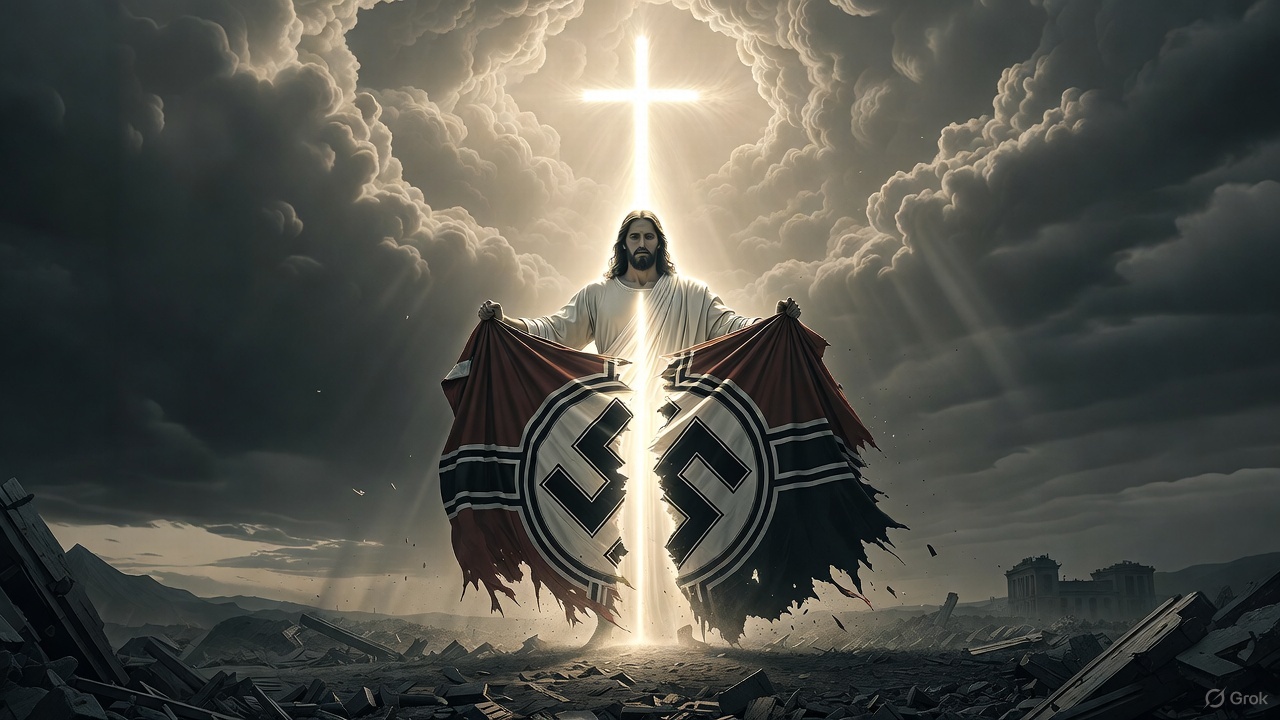
The exemplary case is Adolf Hitler, a man of preternatural instinct for threats to his authority. Hitler never wasted energy on an enemy he did not regard as dangerous. And so he persecuted priests, censored bishops, dissolved Christian schools, criminalized Christian youth groups, and sent pastors like Martin Niemöller and theologians like Dietrich Bonhoeffer into prisons and camps. He dispatched informants into churches to monitor sermons, rewrote the Bible in places to conform to Nazi ideology, and had entire dioceses placed under surveillance.
But for all this furious activity, Hitler somehow forgot to persecute atheists for their views on God.
This omission is not one of history’s footnotes. It is the key to his worldview.
It has been argued by historian Tom Holland that Hitler hated Christianity for two principal reasons: it rejected an ethos of power in favor of caring for the weak and oppressed; and it rejected racialism, declaring that “There is neither Jew nor Greek, there is neither slave nor free, there is no male and female, for you are all one in Christ Jesus.”
That is no doubt true, but it misses a larger truth.
Hitler hated Christianity for one reason above all: it did not acknowledge him. Christianity places God above the state, conscience above the Führer, and moral law beyond the reach of the racial myth. It teaches, in a tone Hitler recognized as a direct rebuke, that “we must obey God rather than men.” Atheism, by contrast, offers the dictator a blank sheet of moral paper upon which the state may write as it pleases.
He said as much behind closed doors. In Hitler’s Table Talk, his private conversations recorded by his inner circle, he did not mince words, saying “the heaviest blow that ever struck humanity was Christianity,” that “Christianity is a rebellion against natural law, a protest against nature”; and that “The Christian doctrine of love is incompatible with our worldview.” Not surprisingly, he declared “When once our position is established, we’ll abolish the Christian religion.”
These are not the opinions of a man quibbling over theology. They are the opinions of a man who recognizes in Christianity a rival universe of meaning and power.
His lieutenants were, if anything, even more explicit. Martin Bormann declared: “National Socialism and Christianity are irreconcilable.” Joseph Goebbels wrote: “The Führer is deeply hostile to Christianity”; and “The churches cannot be allowed to interfere with the state… Their influence must be broken completely.” Heinrich Himmler promised: “We will not tolerate Christian ideas of compassion;” “Christianity is incapable of bringing up a race of men”; and We shall not rest until we have rooted out Christianity.” And Alfred Rosenberg insisted: “The Christian religion is incompatible with the racial conscience”; and “The Christian churches have become the chief obstacle.”
These were not rhetorical indulgences. They became policy. And again, there was no corollary policy against atheism, because it posed no threat to them.
By the war’s midpoint, the anti-Christian campaign had become quantifiable in its scale. More than 3,000 Christian leaders, mostly Protestant pastors of the Confessing Church, were imprisoned for resisting state control, alongside roughly 2,700 Catholic clergy who passed through Dachau alone, including over 1,700 priests, 400 seminarians, more than 300 monks and friars, and around 50 nuns. Over 1,000 clergy died in the camps or were executed outright. The regime shuttered more than 10,000 Christian schools and charities, closed hundreds of convents and monasteries, dissolved dozens of seminaries, and targeted a third of Catholic parishes with harassment and arrests. More than 7,000 clergy and devout laity were under Gestapo investigation in any given year. By 1945, virtually every Christian denomination in Germany had been infiltrated, censored, harassed, or partially dismantled.
And while many atheists suffered under Hitler — no tyranny confines its cruelties neatly — not a single person was persecuted for being an atheist, full stop. The Third Reich never banned atheism, never sought to manipulate it, never raided homes for unbelief, never censored literature for irreligion, never sent anyone to a camp for denying God. The only atheists Hitler targeted were communists, and in those cases it was politics, not metaphysics, that invited the persecution. Hitler couldn’t care less that a man denied God. What he feared, and set out to destroy, was any worldview, Christianity above all, that placed a higher authority above himself.
A tyrant does not fear unbelief. A tyrant fears conscience. And Christianity produces conscience at scale.
But let us go one step further, and here bring a proper indictment. Hitler was not just threatened by Christianity in a way that atheism could never threaten him. It was the decline of Christianity, and rise of secularism, that led to Hitler.
By the time Hitler entered public life, Europe’s intellectual classes had already spent decades drifting away from Christianity and toward a brisk, self-assured secularism. In universities, salons, and parliaments alike, the old moral architecture rooted in the image of God was being dismantled and replaced with the new enthusiasms of scientific materialism and social Darwinism. Nietzsche announced the “death of God.” Darwin’s theories were crudely misapplied to human society (though, come to think of it, Darwin himself titled his magnum opus On the Origin of Species by Means of Natural Selection; or, the Preservation of Favoured Races in the Struggle for Life, so perhaps this was not entirely unintended). And fashionable progressives spoke coolly about sterilizing the unfit and pruning the weak. These conversations soon became policy — as they tend to do — even in the United States, where forced sterilizations based on I.Q. scores were upheld by the Supreme Court. Go read the Buck v. Bell case, where Justice Holmes declared, with chilling simplicity: “Three generations of imbeciles are enough.”
This milieu created the vacuum into which Hitler strode, and gave him intellectual backing, presenting himself not as a monster, but as the logical heir to a worldview that had already discarded the sacredness of the human person in favor of the cold calculus of natural selection and the preservation of favoured races. Hitler did not invent racial science or eugenics; he merely carried secular progressivism’s cold logic to its grisly conclusion. Christianity resisted him. Secularism created the vacuum that allowed him.
We spend endless time diagnosing tyranny by its outward symptoms. We compare modern nations to past horrors and ask whether this or that rhetoric, this or that policy, this or that prejudice resembles something out of 1930s Germany. Is it centralized power? Racial animus? Hostility toward immigrants? Restrictions on speech? Economic control? My friends, these are merely the visible eruptions, the fevers and chills of a deeper illness. The real antecedent — the condition without which tyranny cannot exist — is always the same: the state has become the supreme authority. Where the state is ultimate, tyranny is inevitable. Where something stands above the state — God, conscience, natural law, a transcendent moral order — tyranny is thwarted. Even democracy offers no guarantee, for “the people,” though supreme for a time, can and will hand their autonomy to the state in exchange for protection, provision, or the warm bath of ideological certainty. The line dividing tyranny from freedom is not between left and right, nor between nations and centuries. It is drawn at the point where human authority encounters a limit — and whether that limit exists at all.
One need not be a believer to grasp the point. It was Christianity, not unbelief, that Hitler regarded as his adversary. It was Christian conscience, not secular relativism, that he found intolerable. And it was Christianity, with its stubborn insistence on a higher King and a higher law, that prevented the totalitarian state from becoming absolute.
So by all means, dismiss Christianity if you must. Mock it if you wish. But do not flatter yourself that doing so places you among the enlightened. You stand, knowingly or not, with those who hated Christianity for the same reason Hitler did: not because he was enlightened, but because Christianity was the antithesis of him.
You may also be interested in:
- Why Bonhoeffer Matters – Conservative Opinion
- The Real Reason Many Famous Atheists Reject God – Conservative Opinion
- C.S. Lewis Warning for America: A Call to Reflection – Conservative Opinion
- A Great Civilization is a Merciful Civilization – Conservative Opinion
- Why Jordan Peterson Still Won’t Call Himself a Christian – Conservative Opinion
- The Surprisingly Christian Message of “The Ides of March” – Conservative Opinion
- Musk is Wrong: Empathy is Our Strength – Conservative Opinion