

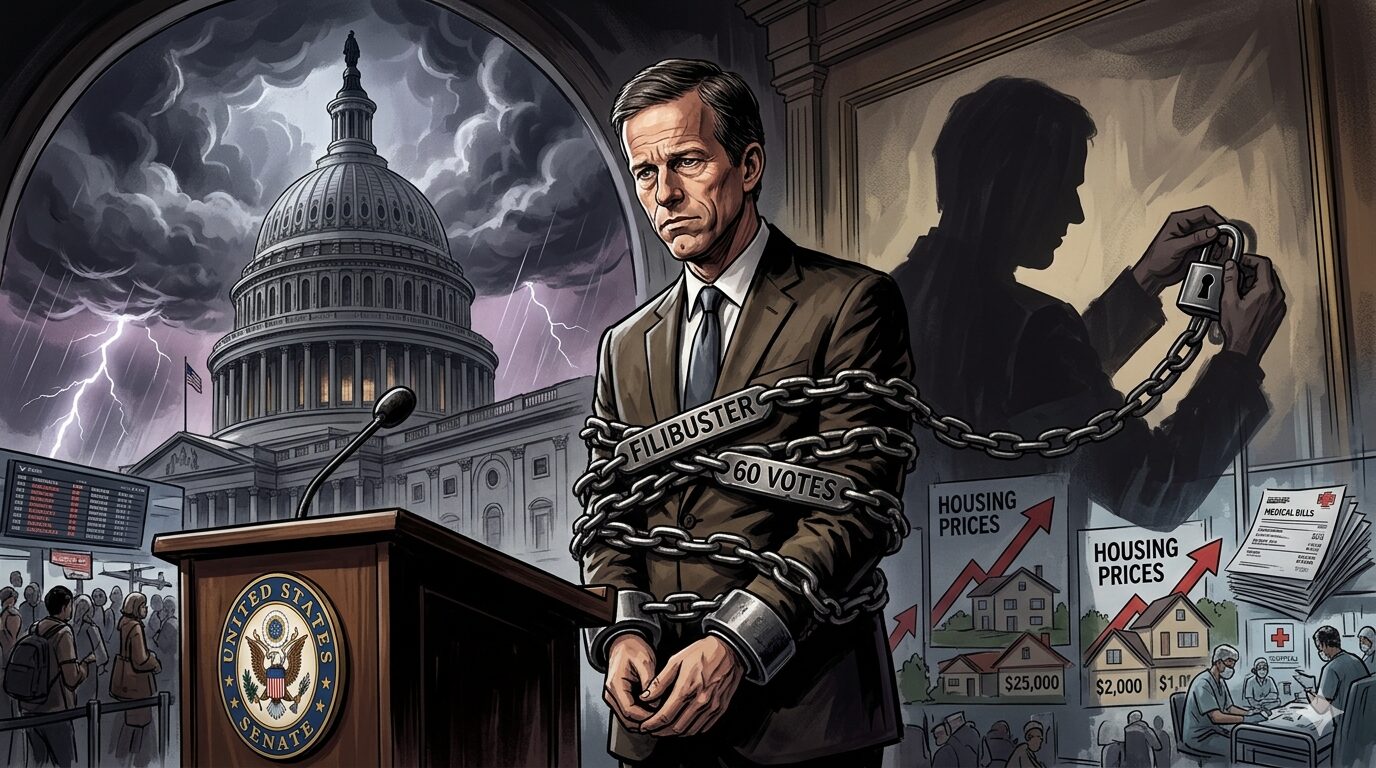
I have a memo to my Republican colleagues. And this is top-secret stuff here, so be careful who you share this with: when Republicans control the White House, the House of Representatives, the Senate, and the courts, voters will not blame Democrats when America does not function. And right now, America is not functioning. Chaos at the airports? Voters will blame Republicans. Housing is unaffordable? Voters will blame Republicans. Healthcare is unaffordable? Voters will blame Republicans. College is unaffordable? Voters will blame Republicans.
And they should! These are failures of government, and if government is failing, the party in power has nobody other than themselves to blame. Republicans are supposed to be stewards of the American dream, and when it becomes out of reach for too many Americans, we have to act, or else we will be punished.
And yet we do nothing. Not because we lack votes, but because our Senate Majority Leader, John Thune, has decided that no significant legislation is allowed to be voted on unless it can secure sixty votes to overcome a self-imposed filibuster. Not fifty-one, which is what the Constitution requires for ordinary legislation. Sixty, an arbitrary supermajority threshold that does not appear anywhere in the Constitution but now functions as an all-purpose alibi for inaction.
That’s right, we are actually filibustering ourselves. Not Democrats! We are in power and are actually filibustering our own agenda.
So, no, we cannot have voter identification laws. No, we cannot replace Obamacare. No, we cannot address the affordability of anything, because you need 60 votes to break the holy filibuster, even though we can vote to change the rules and eliminate the filibuster with a simple majority vote.
At some point, the excuse becomes the problem.
It is highly likely that in a nation that has become as divided as ours, and with those divisions only growing wider and deeper, we will never again have a 60-vote majority. Is the plan then to wait for the unlikely to happen before we govern, when waiting and doing nothing makes gaining votes even more unlikely?
There was a time when the filibuster could plausibly be described as a guardian of liberty. In that distant era, the federal government was modest in ambition, restrained in scope, and largely confined to its enumerated tasks. A procedural device that slowed legislation could therefore be praised as a hedge against centralization and an ally of federalism. But that defense collapses under modern scrutiny.
To defend the modern filibuster as an instrument of limited government is to defend a ghost. The federal government has already expanded beyond anything recognizable to the framers, or even to our parents. We now live under a vast regulatory superstructure governing healthcare, housing, finance, education, labor, energy, and the intimate details of daily life. And yet the Senate’s 60-vote rule remains, not as a shield against expansion, but as a lock sealing in the expansion already achieved. The filibuster did not prevent this expansion; it merely ensures that once expansion occurs, it becomes nearly impossible to reverse. The result is not limited government, but paralysis.
Worse still, the paralysis of Congress has not constrained power; it has relocated it. Power abhors a vacuum. When Congress refuses to legislate, the vacuum does not remain empty. It is filled by an imperial executive and by administrative agencies that now function as lawmakers in all but name.
One of the great myths of modern politics is that Washington “doesn’t get anything done.” No, Republicans don’t get anything done. Congress doesn’t get anything done. Washington gets far too much done. Federal agencies routinely issue roughly 3,000 final rules per year. In some years, regulations have outnumbered congressional statutes by nearly twenty to one, and all of these rules and regulations have the effect of law. They bind businesses, burden citizens, and reshape industries. And they are drafted not by elected representatives debating in public committee rooms — because they’re too busy filibustering — but by career officials insulated from direct electoral accountability.
Defenders of the 60-vote rule warn that eliminating it would lead to instability, that laws would swing wildly with electoral changes. But we already live in instability. It simply manifests through executive oscillation rather than legislative change. Energy policy changes by memorandum. Immigration enforcement shifts by directive. Healthcare rules are rewritten by regulatory interpretation. Student loan obligations are adjusted by administrative decree.
This represents a complete constitutional inversion. The Constitution created Congress to make law and an executive to execute it. It did not create a permanently paralyzed Senate and an imperial presidency that toggles national policy by executive order and bureaucratic appointments every four years.
If voters elect a majority to repeal a law, repeal it. If they dislike the result, they can reverse course in the next election. That is democratic accountability. What we have now is something murkier: responsibility diffused among presidents, agencies, and courts, while Congress pretends its hands are tied, when in fact, it simply chooses to sit on them.
The irony of this is that the Constitution was meant to be a rejection of the old British Monarchy, but through the filibuster the United States Congress has reduced itself to exactly that: a body rich in history and ceremony, endlessly invoked, rarely decisive, and largely irrelevant to the exercise of real power. Of all the modern political inversions, this the most consequential.
In short, the filibuster has become less a shield against tyranny than a guarantee of legislative irrelevance, and since Republicans are in control of the legislature, Republican irrelevance. Don’t expect the Democrats to be contented with irrelevance when they win back control of the government.
Oh, please! Don’t tell me that we need to keep this filibuster forever in place to handcuff the Democrats for the day they regain power. The Democrats aren’t stupid. There cannot be any real doubt that the Democrats will eliminate the filibuster the moment they can, a moment that will no doubt be hastened by the idiotic Republican leadership in Congress who refuse to use their legislative majority. The Democrats have made perfectly clear that they have no interest in preserving institutions. The same people who openly state they want to pack the Supreme Court, open the borders as wide as possible, and defund every law enforcement agency will not let some idiotic procedural hurdle get in their righteous way simply because, God forbid, they damage the hallowed institution of Congress. Good luck! Wishful thinking is not a strategy. The answer, then, isn’t to cling to the filibuster and do nothing, and thereby hand power over without even trying; it’s to pass the laws you said you were going to pass when you were elected, and thereby give people a reason to keep you in power and reject the Democratic agenda.
If Republicans wish to prove they can govern, they must stop hiding behind a rule that the Constitution never required. Eliminate the filibuster. Restore majority rule in the Senate. Force Congress to legislate again. And start solving problems!
We cannot ask for the keys to government and then do nothing with it, in hopes that voters will then realize they have to give us a supermajority in the Senate before we do anything. You don’t win more elections by failing. So when we lose this upcoming election, and God only knows how many more, don’t blame the voters or the system, or delude yourself into thinking that the election was stolen. That is actually how democracy is supposed to work. If anything would be suspicious, it would be for Republicans to win after letting the country down.
So my message to my Republican friends is this: if you’re not going to do your job, don’t be surprised when you lose it, and that’s exactly what’s coming down the road. Because for a party that prides itself on merit-based hiring, it is not doing much to merit its continued employment.
You may also be interested in:
- Republicans are Failing to Solve Serious Problems – Conservative Opinion
- When Power Operates in the Shadows – Conservative Opinion
- New Jersey Republicans Have Perfected the Art of Losing – Conservative Opinion
- Beyond the Ban: What Conservatives Must Put Into the Classroom – Conservative Opinion
- A Trump Anti-Crime Bill, not the National Guard, is the Ultimate Solution – Conservative Opinion
- On School Shootings: Faith Without Works is Death – Conservative Opinion