

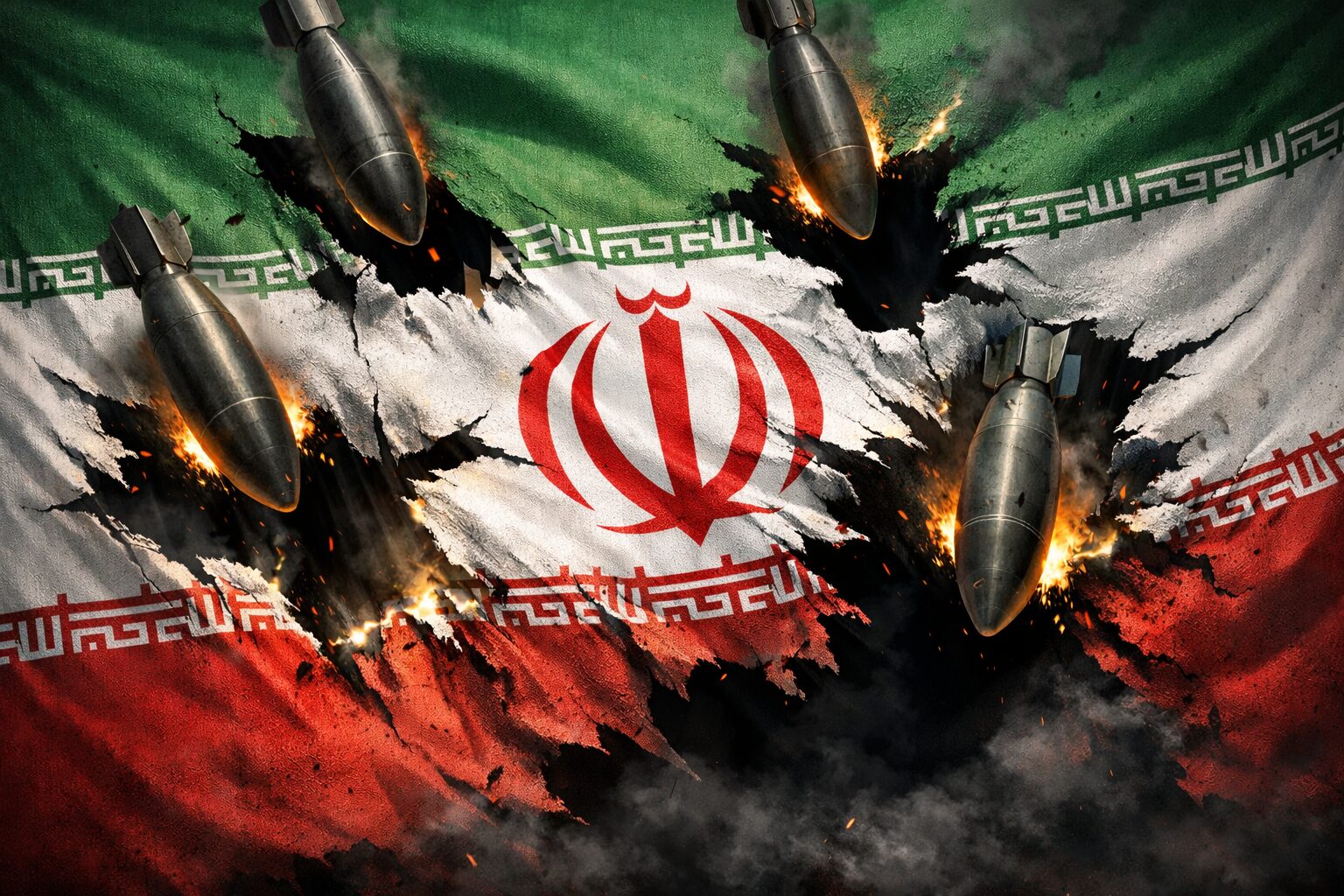
It is tempting to be roused to celebration at the sight of bombs falling on a regime that richly deserves it. Iran’s government is cruel, destabilizing, and openly hostile to American and Israeli interests. It remains the leading state sponsor of terror. There’s every reason to believe it continues to enrich uranium to use eventually in nuclear weapons. They function as the Middle Eastern pillar of an axis aligned against us, led by China and Russia, with proxy extensions in Hamas, the Houthis, and Hezbollah. I’m glad the Ayatollah and his henchmen got what was coming to them. Absolutely. Few tears need be shed for its rulers. But like most temptations, the urge to celebrate so soon is better resisted than indulged. It is easy to identify an enemy. It is folly to believe that a single night of bombing will undo half a century of ossification.
We are not pacifists. Iran represents a real threat. There is a strong case to be made that we cannot avoid conflict even if we want to, and that in such conflict, the military option is the right one. There is also such a thing as a fear dividend. When a regime sees that defiance carries consequences, others watching take note. Power demonstrated alters calculations far beyond the immediate target.
But force without follow-through, especially of the unilateral sort, is not strategy. At least, not a good one. And the belief that bombing Iran will produce meaningful political change is not merely optimistic, it is unserious. There will not be, and as of this writing have not been, any spontaneous uprising triggered by these airstrikes. The Iranian people will not make any meaningful attempt to topple the government. And even if that did occur, and it were successful, it would be fantasy to believe the result would be a wiser, freer, or more pro-Western government. You do not spend generations teaching a population that America and Israel are the enemy and then expect goodwill when those enemies arrive by air. Bombs do not dissolve ideology. They confirm it.
This faith in bombing as a catalyst for democracy is an old superstition dressed up as resolve. We return to it repeatedly, as if the last failures were execution errors rather than conceptual ones. Dropping bombs and hoping democracy springs from the craters like dandelions has never proven effective. Not in Iran. Not in Venezuela. Not in Libya. Not anywhere that lacked the institutional soil to sustain it. Force can break a state. It cannot manufacture civic trust, political habits, or legitimacy.
What military strikes reliably produce is not liberal reform but nationalist consolidation. Under external attack, populations rally around the symbols of the state, even when they privately loathe those who rule it. Foreign violence validates regime propaganda, suppresses internal dissent, and grants authoritarian governments the legitimacy they perpetually lack. Fear is a more efficient political tool than persuasion, and Tehran understands this far better than Washington pretends to.
This ballistic diplomacy, characterized by a short burst of violence followed by nothing at all, allows regimes to absorb the blow, control the narrative, and reassert internal authority. You can take out the head, but like the decapitated Hydra, another grows in its place, and the act of striking accelerates regeneration.
There is also a historical irony that should temper any enthusiasm for episodic force. We rarely mention military intervention in Iran without recalling our fiasco in Iraq, and for good reasons, not least of which is to remember the cost in blood, money, and credibility, and ask whether we are actually willing to pay it again. If the answer is no, then someone needs to explain, clearly and honestly, why this will be different. I too want to celebrate the moment. But Iraq taught us a lesson we ignore at our peril: the war is easy. Making the peace is hard.
And speaking of Iraq, let us not forget that Iran is resurgent today because we neutered Iraq. The entire purpose of the Iraq War was to create a new democratic partner in the Middle East to counter the more unstable regimes, anchor a broader transformation in the region, and become a model for gradual liberalization in neighboring states, including Iran. But the decision to overthrow Saddam Hussein removed Iran’s most formidable regional rival. Whatever else Saddam was, his regime functioned as a strategic barrier to Iranian expansion, much like bacteria keeps fungus in check. Two decades later, where is that partner now? When the Iraqi state was dismantled, we did not merely depose a dictator; we destroyed a counterweight. Tehran moved quickly to fill the vacuum through militias, political influence, and proxy warfare. The result was not a weaker Iran, but a stronger one.
This, incidentally, was not an unforeseeable outcome, but its most predictable.
The lesson of Iraq is not that force is illegitimate. It is that force without endurance reshapes the board in ways that often advantage the very actors it was meant to contain. If we do not intend to stay, to shape, and to own the aftermath, then we are not practicing deterrence. We are smashing up the living room and calling it renovation.
None of this is an argument for appeasement. If Iran truly poses an existential threat, and I believe it does, then one night of bombing is grotesquely insufficient. And if regime change is the goal, then hoping for a popular uprising is not a strategy but a superstition. Both objectives require real commitment beyond dropping bombs. They require sustained pressure, clear demands, international commitment, and political ownership. They require Congress, and they require allies.
What we have instead is a far more corrosive posture. We are willing to exceed constitutional limits to initiate force, but suddenly rediscover restraint when consequences appear. We bypass Congress to act, then hide behind caution to avoid responsibility. We are bold where authorization is weakest, and timid where seriousness would demand resolve. In doing so, we neither honor the Constitution nor commit to strategy. We merely advertise the outer boundary of our willingness to act.
The danger, then, is not that we have awakened a sleeping giant. It is that we have revealed ourselves as a power prepared to strike impulsively, but unwilling to bear the costs of strategy, legality, or consequence. We demonstrate not strength, but incoherence: our willingness to break rules to act, and our reluctance to finish what we start.
Serious foreign policy is rarely satisfying. It is slow, unglamorous, and often incomplete. It requires patience, alliances, pressure, and an honest assessment of what force can and cannot achieve. What it does not require is theatrical violence undertaken for the appearance of action.
I hope I am wrong about all of this. History is rarely generous to precise predictions, and no one can see the future with certainty. But when the outlook is murky, the least likely outcome is often the easiest one to identify. And the least likely outcome here is that from this rubble will emerge a new democracy friendly to America and our allies, absent significant sustained intervention.
You may also be interested in:
- Of Nukes and Nonsense: Dumb Arguments for a Nuclear Iran – Conservative Opinion
- On Venezuela: Sovereignty, Legitimacy, and the Return of American Hegemony – Conservative Opinion
- From Goodfellas to Godfather: How Trump Sees Ukraine – Conservative Opinion
- President Strangelove: How Obama Learned to Stop Worrying and Love the Bombs – Conservative Opinion
- President Obama’s Non-Answers Regarding the Non-War in Libya – Conservative Opinion