

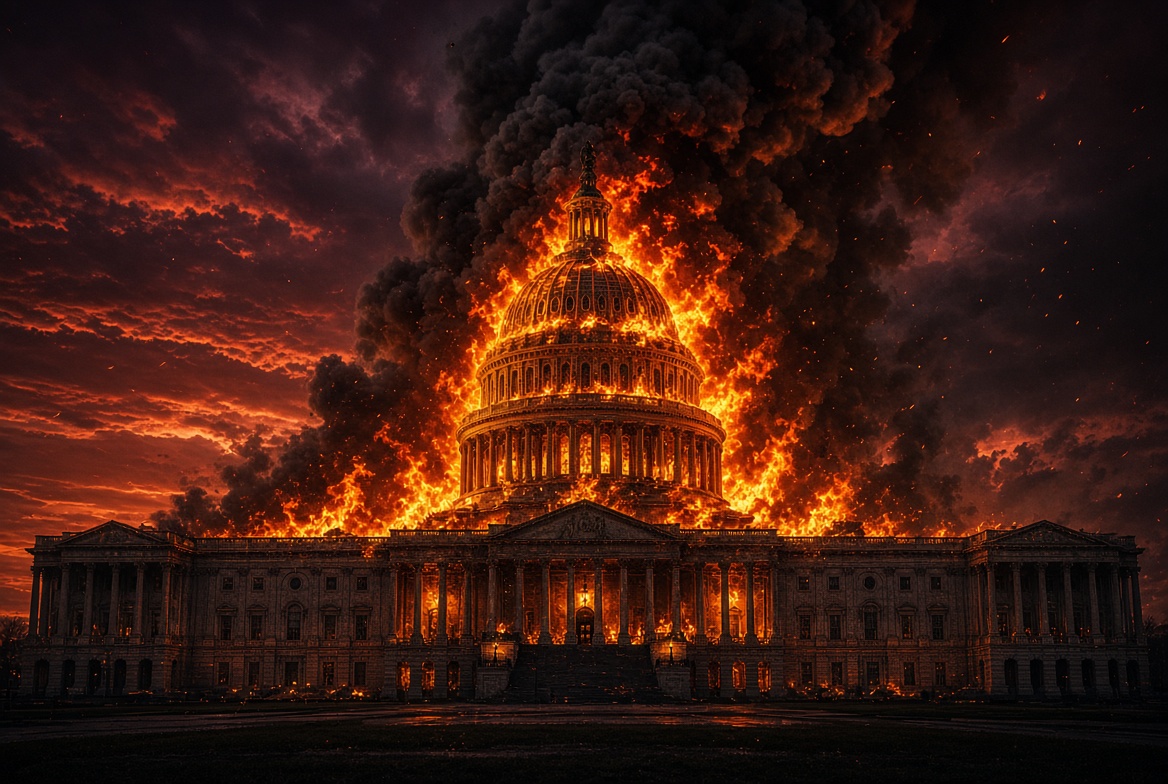
Last December, I wrote an essay entitled Republicans Are Failing to Solve Serious Problems, in which I warned that Republicans had become so enamored of winning elections that they had seemingly forgotten what elections were for. I identified housing, healthcare, and higher education as three essential pillars of American life that were becoming increasingly unaffordable, and challenged Republicans to do something about them. These, I said then, “are not luxuries, or whimsical indulgences of the Left. These are foundational elements of a stable society. And the reasons for their skyrocketing costs are neither mysterious nor unsolvable. Yet Republicans, who now control the levers of government, are doing essentially nothing.” In April, I wrote another essay warning that the party’s legislative paralysis would be punished at the ballot box. I explained that when Republicans control the government, voters will not blame Democrats for its failures, and that no amount of finger-pointing or procedural excuse-making would absolve us of our responsibilities. The warnings were neither particularly imaginative nor difficult to understand. They required only the elementary observation that people elect governments to govern, and that governments which fail to govern eventually lose the privilege.
Well, here we are. Republicans have been completely and predictably annihilated, and richly deserved it. I take no pleasure in being right.
The Republican Party was entrusted with Congress and the presidency not as a reward for its accomplishments, of which there have been precious few of late, but because Americans expected it to make their lives better. And this is where Republicans have fundamentally misunderstood the nature of political leadership. Elections are not ultimately about telling voters what you believe. This was not a failure of messaging. We failed to show voters what our beliefs can accomplish. Show them affordable healthcare. Show them a university education that doesn’t require a lifetime of indebtedness. Show them a housing market in which middle-class families need not become millionaires to purchase ordinary homes. Show them a stronger dollar, a balanced budget, and an American Dream that remains within reach of the next generation. Instead, Republicans spent two years celebrating their own electoral magnificence, fighting yesterday’s battles, and congratulating themselves for occupying offices in which they apparently felt no obligation to accomplish anything.
It’s actually kind of funny listening to Republicans denounce Democrat voters as lazy and entitled, when one struggles to imagine a more impressive exhibition of laziness and entitlement than that displayed by so many elected Republicans themselves. These are people who campaign on the virtues of hard work, personal responsibility, and merit, only to arrive in Washington and behave as though the mere possession of public office entitles them to its indefinite renewal. They produce little, demand considerable gratitude, and regard the suggestion that they ought actually to accomplish something as an impertinence. They have somehow managed to combine the work ethic of the idle with the expectations of the aristocracy, all while delivering lectures to the rest of America about the dangers of entitlement. Well, sorry, but a political party that insists Americans must earn what they receive should hardly be surprised when voters apply that same standard to the politicians asking for their votes.
There is something profoundly sad about this election, and I don’t just mean the loss of Congress, but rather that while Democrats are celebrating their victories, theirs is a triumph born largely of human suffering. Americans are struggling to afford homes, healthcare, groceries, and the education of their children. Young people are entering adulthood saddled with debts that would once have purchased a respectable house, only to discover that the house itself is now beyond their reach. These are not the imaginary grievances of an affluent society searching for something to complain about. They are the increasingly desperate circumstances of ordinary people trying to live ordinary lives. I do very well financially, and even I find the world astonishingly expensive. How young families and people earning ordinary salaries manage to make ends meet is something I genuinely struggle to comprehend. And while Democrats may be delighted with the electoral consequences, there is nothing to celebrate about the misery that helped produce them.
Naturally, the postmortems have already begun, with Republicans explaining that the real problem was the war in Iran, or Trump’s personality, or some other catastrophe that conveniently absolves Congress of responsibility. Certainly, the Iran war was a mistake, and one about which I had been sounding the alarm from day one, long before yesterday’s newly minted prophets discovered their objections. But the suggestion that this election was principally a referendum on Iran misses the larger failure. Had Americans been enjoying affordable healthcare, accessible housing, manageable college expenses, and a rising standard of living, the war would have existed in a very different political environment. Barack Obama dropped bombs across multiple countries and somehow still managed to collect his Nobel Peace Prize and re-election. Americans have historically tolerated bombing enemies from a safe distance, when they believed their lives at home were improving. But when the mortgage is unaffordable, the grocery bill is punishing, and the future looks increasingly bleak, a government that busies itself with another war, while doing nothing about real problems at home, merely adds insult to injury.
Consider healthcare. Republicans have been campaigning against Obamacare for nearly two decades, which is quite an impressive duration for a political grievance that has produced no comprehensive, workable replacement. One might reasonably have expected that, somewhere between the first denunciation and the ten-thousandth fundraising email, somebody would have developed a serious alternative. But apparently identifying a problem, attaching the name of a Democrat to it, and complaining about it indefinitely is now considered a governing philosophy. The same intellectual lethargy infects discussions of college affordability, housing costs, and fiscal responsibility. These are difficult problems, certainly, but not insoluble mysteries beyond the comprehension of human civilization. Conservatives have serious ideas available to them. What seems to be missing is the imagination, energy, and political initiative to pursue them.
Instead, Congress has become a club for the comfortable, a ceremonial position for the self-congratulatory, where the principal responsibilities appear to consist of casting easy votes, attending fundraisers, and securing reelection to a job whose actual duties have become almost entirely incidental. Its members present themselves as indispensable, although one searches in vain for evidence of their indispensability. And now the voters have demonstrated just how dispensable they really are. Republicans had every opportunity to replace their complacent incumbents with genuine leaders. Having declined to do so themselves, they left the task to the opposition.
We do not need professional fundraisers, perpetual incumbents, and politicians who have mistaken longevity for leadership. What we need are thought leaders, people with some intellectual curiosity, some original ideas, and enough passion to regard public office as something more than a comfortable retirement plan.
Unfortunately, the modern Republican Party has elevated a rather different sort of intellectual specimen, whose most sophisticated political calculation runs something like this: “If I say Trump, I get elected! But now if I say Trump, I get not elected! This is hard! I want a juice box!” These are not statesmen wrestling with the complicated demands of representative government. They are overgrown children whose understanding of politics begins and ends with the identification of whichever personality might provide them with the easiest route to power. And having hitched their fortunes to a president whose historic unpopularity was hardly a closely guarded secret, they now seem astonished that the public has declined to reward their servility. Maybe spending two years doing nothing for ordinary Americans while defending every presidential provocation was not, after all, the political masterstroke they imagined.
The deeper problem is that Republicans have confused the grievances of their loudest supporters with the priorities of the American electorate. Perhaps Americans never cared quite so passionately about the “deep state” as the professional grievance merchants assured us they did. Perhaps — here’s a thought — they wanted somebody to make healthcare affordable rather than somebody to devise another elaborate explanation of why their enemies are evil. Perhaps they were less interested in settling political scores than in paying their mortgages.
And this, I suggest, is the most damning indictment of all. A party without ideas is a party without imagination, and a party without imagination is inevitably a party without vision. Its leaders cannot conceive of a better future, and so they devote themselves to relitigating the past. They cannot imagine what America might become, or even what America is, so they content themselves with congratulating America for what it once was. They have no conception of greatness beyond its invocation, no program for prosperity beyond its promise, and no governing philosophy beyond the identification of their enemies. The Bible tells us that where there is no vision, the people perish. Republicans might consider the possibility that this is not merely a warning about the political fortunes of those who fail to lead, but about the fate of the people who have entrusted them with leadership.
On that point of leadership, let us return for a moment to President Trump, whose extraordinary unpopularity, reflected in a net approval rating regularly around negative twenty points, is less a closely guarded secret than it is a national embarassment. Republicans who pretended that he was neither on the ballot nor a major part of the problem managed only to delude themselves. One suspects that had Trump been popular and Republicans prevailed, these same people would have been falling over themselves to give him all the credit. But this is nothing new. These are the same people who insist that polls are meaningless unless they are even marginally favorable, at which point they become unimpeachable evidence of an impending landslide. To acknowledge Trump’s influence when Republicans win, while insisting that his extraordinary unpopularity had nothing to do with their defeat, is an exercise in intellectual dishonesty that would be almost impressive were it not so transparently absurd.
Enough is enough. The situation is now desperate. In the Book of Jonah, a ship is caught in a violent storm, and its sailors discover that the only way to save themselves is to cast Jonah overboard. There comes a point when loyalty to one man must yield to the preservation of something larger. Republicans now confront that question with an urgency they can no longer afford to dismiss. With Democrats controlling Congress and the country still beset by the problems Republicans promised to solve, the next two years will offer little room for further self-indulgence. The party must decide whether its purpose is to preserve conservatism and the American institutions it claims to cherish, or to preserve the political fortunes of a single individual. If the former, it’s time for Trump to put on his swim trunks.
But even rebuking Trump would accomplish little if Republicans remain determined to replace one personality cult with another, and one collection of intellectual lightweights with an equally uninspiring collection of successors. The party needs a wholesale reconsideration of what it believes political power is for. Conservatism is not a spectator sport in which politicians congratulate themselves for denouncing the other team. It is a philosophy of stewardship, of preserving what is valuable, repairing what is broken, and ensuring that the civilization we inherited remains worthy of inheritance by those who come after us. You cannot claim to be the stewards of the American Dream merely by celebrating the greatness of the America you inherited. You must leave it greater, and its opportunities more attainable, for the Americans who follow.
Republicans were given the keys to government and mistook possession for accomplishment. They promised to make America great again, yet apparently never considered that greatness might be measured by something more substantial than the number of political enemies humiliated or the volume of applause at a campaign rally. They were asked to govern, and instead they performed. They were asked to solve problems, and instead they found people to blame. They were asked to preserve the American Dream, and instead they treated its invocation as a substitute for its preservation. And now, having squandered the public’s confidence, they seem genuinely bewildered that the public has decided to look elsewhere.
There is a particularly bitter irony in all this. Republicans have spent years warning that Democrats intend to transform America into a socialist state. Yet by refusing to address the economic conditions that make radical promises attractive, Republicans have accomplished what Democrats themselves could scarcely have dreamed of accomplishing so quickly: they have made increasingly radical economic proposals more appealing to an electorate desperate for relief. When people are prosperous, they can afford to be skeptical of grand political experiments. When they are suffering, the promise of something, however dubious, begins to look preferable to the certainty of nothing. America has not necessarily rejected conservatism in favor of socialism. It has rejected doing nothing in favor of trying something.
Unfortunately, the blast radius extended far beyond those responsible, bringing down Republicans throughout the ticket. I feel genuinely sorry for the many decent Republicans serving at the state and local levels who lost their elections because of the failures of their national party. These people were made to bear the consequences of decisions over which they exercised little control, while the architects of the disaster will undoubtedly spend the coming months appearing on television to explain why everybody else is to blame. That’s already started.
And perhaps that’s the worst part about this, that nobody seems to have learned anything. Once again, the loudest voices today belong not to those of us who had been warning about this all along, but to the very people who have been wrong about practically everything, yet somehow awaken the morning after an electoral catastrophe to present their learned diagnosis, which never seems to point a guilty finger in their direction. Well, let me let you in on a little secret: the American people didn’t just reject Trump and the Republicans in Congress. They rejected you, too.
Republicans richly deserved their defeat. The American people did not deserve the suffering that produced it. And the Republican Party had better learn the difference very quickly because we’re one more election defeat away from it all being too late. It may already be.