

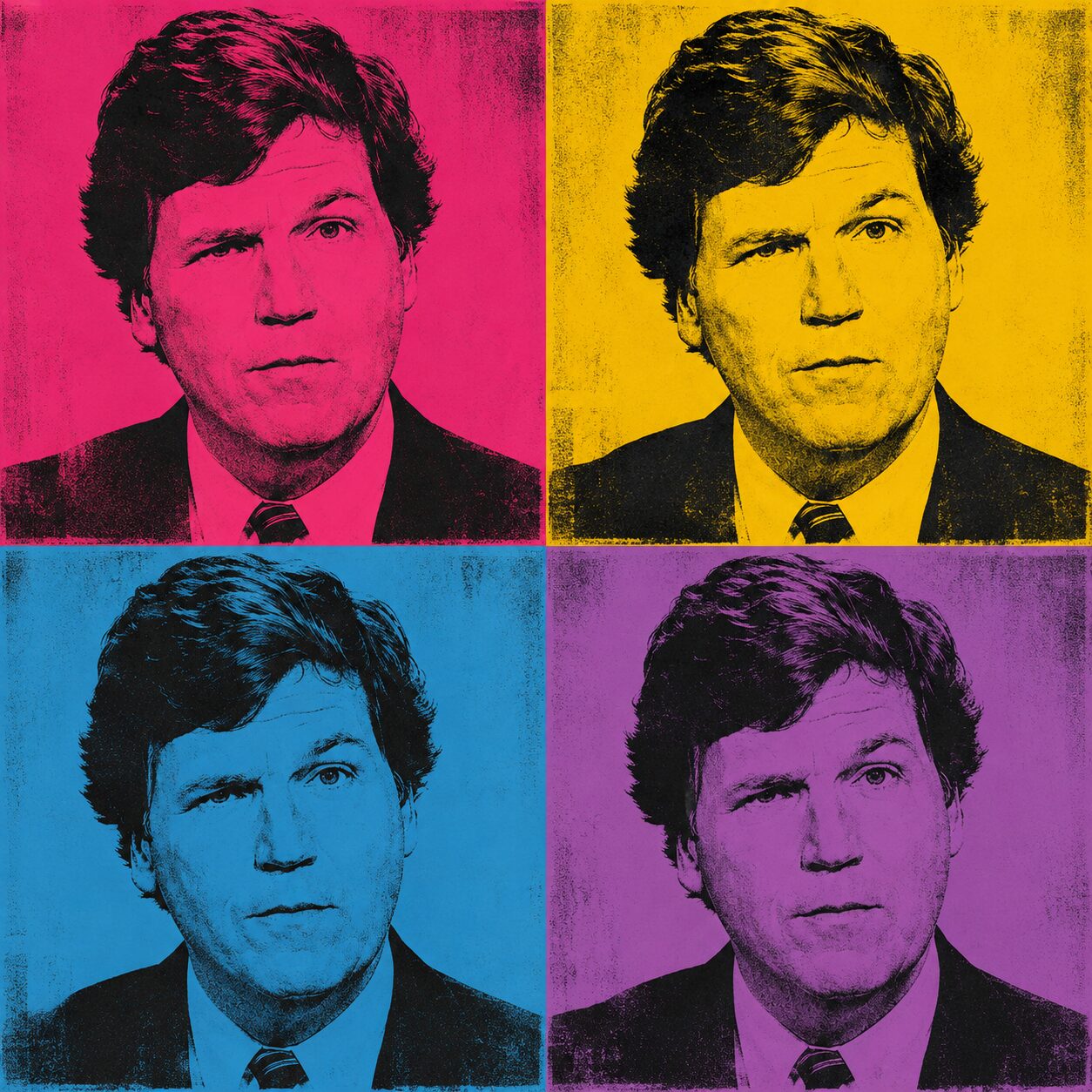
There are, by my count, at least four Tucker Carlsons, and one of the great pleasures of watching him is discovering which one has reported for duty. They have the same face, the same wounded, befuddled expression of a prep-school boy disciplined for a minor dress code violation, and the same air of perpetual astonishment that the world has failed once again to arrange itself according to his expectations. But they are nevertheless quite different creatures, and the particular Tucker who appears seems to depend almost entirely upon the quality of the person sitting across from him.
The first Tucker is the one most familiar from his Fox News years, when some producer would apparently scour the continent looking not for a worthy opponent, but for an especially idiotic progressive activist to explain on television that mathematics is racist, punctuality is white supremacy, boys can get pregnant, or some other proposition sufficiently preposterous that Tucker could defeat it without removing his hands from his pockets. These encounters were marvelous television in the way that watching a professional boxer fight an accountant might be marvelous television. Tucker would furrow his brow, widen his eyes, permit his guest to say something spectacularly foolish, and then ask the sort of devastating question that only becomes devastating when addressed to someone who should never have been booked on television in the first place.
There is value, I suppose, in exposing lunacy, if only because Leftist lunacy from yesterday has a way of becoming today’s dogma — whoever thought we’d live to see the day that “women” were replaced by “pregnant persons”? — but Tucker versus an imbecile was more Jerry Springer News than cultural advancement, an easy target to point and laugh at for amusement and little else.
There was nothing necessarily dishonest about pointing out that such people existed. They did exist, and some of the ideas Tucker mocked deserved every ounce of mockery they received. The dishonesty, if one wishes to call it that, was curatorial. The lunatic was not presented as a lunatic but as an ambassador. One was invited to believe that somewhere in the faculty lounge at Harvard, the editorial conference at The New York Times, and the weekly meeting of the Democratic National Committee, serious people were nodding solemnly along with the undergraduate who had just explained to Tucker that two plus two equals four only because Western imperialism says so. The opponent had been defeated before the cameras were switched on. All that remained was the taxidermy.
Then there is the second Tucker, who is so different from the first that one wonders whether they have met. This Tucker encounters an extremist from his own side of the political divide — some Nick Fuetes attention whore — and undergoes an astonishing personality change. Suddenly his eyebrows descend, his brow furrows, and the incredulity evaporates. The prosecuting attorney leaves the building and is replaced by a sympathetic parish priest. Tucker is not here to judge anybody. Heaven forbid. He is merely curious. He wants to hear people out. And maybe, just maybe, there’s something to this, some common ground.
This is when the interview becomes less an interrogation than a laundering service. The guest may have accumulated a considerable collection of outrageous opinions, historical fantasies, conspiratorial claims, or political enthusiasms that would ordinarily require a forklift to carry into polite society. But Tucker does not necessarily endorse any of them. That would be crude. Instead, he performs the far more useful service of treating them as though they are simply neglected entries in the great marketplace of ideas, unjustly excluded because the establishment is frightened of uncomfortable truths.
The trick is subtle because Tucker can always insist that interviewing a person is not the same thing as agreeing with him, which is perfectly true. Journalists should interview objectionable people. They should interview extremists, dictators, fanatics, cranks and, when necessary, members of Congress. But interviewing someone seriously requires something more than providing him with upholstery and a microphone. It requires identifying the strongest objections to what he is saying and making him answer them. Curiosity without scrutiny is not journalism merely because the host occasionally raises an eyebrow. Watch his interview with Fuentes, and compare it to the one Piers Morgan did, and see if you get the same impression of that vile person.
This brings us to the third Tucker, who interviews someone who shares one of his darker suspicions and immediately discovers that there is apparently no reasonable alternative interpretation of the matter whatsoever. Here the conversation acquires the atmosphere of two men who have independently discovered a terrible secret and are relieved finally to find someone else brave enough to say it aloud. Whether the subject is Israel, Ukraine, Russia, immigration, vaccines, American intelligence agencies, the decline of Western civilization, or the sinister intentions of whichever institution Tucker has lately discovered is plotting against us, the structure is remarkably consistent. Tucker suspects something and his guest suspects it too, therefore the suspicion has been corroborated.
What disappears from these conversations is not merely “the other side,” as though every interview requires some tedious cable-news arrangement in which a Republican and a Democrat shout campaign slogans at each other until the commercial break. The more important absence is the intelligent dissenter who shares Tucker’s premises but not his conclusion: the conservative who distrusts government without believing that every government action is a conspiracy, the immigration realist who thinks mass immigration has caused serious social problems without concluding that every immigrant is an invading soldier, the critic of American foreign policy who nevertheless recognizes that Vladimir Putin may possess ambitions of his own, the supporter of Israel who recognizes that perhaps not every action Israel has ever taken is entirely defensible, but can nevertheless distinguish between the aggressor and the victim. These are the dangerous guests because they cannot be dismissed as fools or enemies. They concede enough of Tucker’s case to make their disagreement with the rest of it meaningful.
And then, at last, we arrive at my favorite Tucker: Tucker the Indestructibly Uninformed.
This Tucker invites an actual expert onto the program and spends the next hour demonstrating one of the most extraordinary talents in modern broadcasting: the ability to have something explained to him repeatedly without suffering the inconvenience of understanding it. His signature phrase is “I’m just trying to understand,” when he is clearly trying not to understand, but delivered with such earnestness that one half expects a kindergarten teacher to appear with construction paper and crayons.
The pattern repeats itself ad nauseum. Tucker asks some accusatory question in such a way as to imply that he is genuinely curios. The expert offers a perfectly cogent explanation. This puzzles Tucker, so the expert explains again. Tucker reformulates the original misconception as a question, and the expert explains why that formulation is mistaken. Tucker nods thoughtfully, pauses, and then returns to precisely the misconception with which he began, this time become more agitated, demonstrating frustration with his guest’s inability to simply answer the question. Tucker’s refusal to understand, then, becomes evidence that the guest simply cannot explain an indefensible position.
What makes this performance so effective is that Tucker Carlson is obviously not a stupid man. Indeed, stupidity would ruin the entire act. He is intelligent, articulate, quick on his feet, and perfectly capable of following complicated chains of reasoning when those chains arrive at destinations he already finds attractive. His sudden inability to comprehend even very simply explanations tends to emerge at remarkably convenient moments, usually when comprehension would require surrendering the beautifully simple premise upon which the conversation has been constructed.
This is why “I’m just trying to understand” deserves a place among the great rhetorical phrases of our age. It sounds like humility while functioning as armor. Tucker’s failure to understand becomes evidence against the explanation rather than evidence that Tucker has failed to understand it. If an economist, scientist, historian, military officer, physician, engineer or constitutional scholar cannot explain something in a manner that satisfies Tucker’s intuition, perhaps the problem is not Tucker’s intuition. Perhaps the entire profession is hiding something.
The audience is therefore invited to participate in the incomprehension. Tucker does not need to prove the expert wrong. He merely needs to remain unconvinced long enough for the viewer to suspect that there must be some reason for his continued confusion. The expert arrives with twenty years of experience, a doctorate, a stack of data and an explanation of the relevant mechanisms. Tucker arrives with a facial expression and, spoiler alert, the facial expression wins.
There is something almost magnificent about it. Most of us, confronted with an expert who patiently explains why our understanding of his field is mistaken, face the unpleasant possibility that we might have to learn something. Tucker has discovered an escape hatch. He simply keeps asking the question until the explanation becomes exhausted. It is epistemological rope-a-dope. Muhammad Ali absorbed punches until his opponent became tired; Tucker absorbs information.
And now, dear reader, notice something, that the four Tucker Carlsons are not really separate personalities at all. They are four versions of the same method, and once one notices the method it becomes difficult not to see it everywhere. What changes from interview to interview is not Tucker’s worldview but the rules under which the guest is permitted to participate.
When the guest represents a position Tucker despises, Tucker selects the weakest specimen available and attacks. When the guest represents an extreme version of a position Tucker finds attractive, Tucker listens sympathetically and calls it curiosity. When the guest confirms Tucker’s suspicions, agreement becomes evidence. And when the guest actually possesses enough expertise to challenge Tucker’s premises, Tucker retreats into an apparently inexhaustible inability to understand what he is being told, which therefore disproves the thesis.
The result is something more interesting than ordinary political bias. Bias is universal and therefore not especially illuminating. Conservatives complain about liberal journalists, liberals complain about conservative pundits, and everybody goes home satisfied that the other tribe has corrupted the profession. Tucker’s particular genius is different. He manipulates not merely the answers but the apparent range of permissible answers. His programs create a miniature intellectual universe in which the opposing position is ridiculous, the extreme position is intriguing, Tucker’s position is obvious, and the expert position is incoherent.
The common denominator is the disappearance of reasonable disagreement. And that disappearance matters because reasonable disagreement is precisely what makes an interview worth watching. Anyone can humiliate a fool, or flatter an ally, or nod along with someone who confirms his prejudices. The difficult and genuinely illuminating conversation occurs when two intelligent people who understand the evidence nevertheless arrive at different conclusions and are forced to identify exactly where their reasoning diverges. Such conversations rarely produce the delicious certainty of political entertainment. They produce qualifications, distinctions, probabilities and the deeply unsatisfying discovery that the world is complicated.
Tucker’s universe is much more entertaining. There are villains, idiots, conspirators, courageous truth-tellers and, occasionally, experts who cannot seem to explain themselves properly because they are obviously wrong. There is always something enormous being concealed, someone powerful who does not want you to know about it, and one brave man in a studio asking the questions everyone else is supposedly afraid to ask.
And whenever the answer threatens to complicate the story, there is always the final defense. Tucker is just trying to understand. And he is remarkably good at making sure he never does.
You may also be interested in:
- Nick Fuentes: Counterfeit Conservative, Counterfeit Christian – Conservative Opinion
- Keith Olbermann and the Loneliness of Being Ignored – Conservative Opinion
- Note to Don Lemon: The Press Is Not Above the Law – Conservative Opinion
- Capitalism Canceled Colbert, and Capitalism May Yet Save Him – Conservative Opinion
- Democrats Killed Public Broadcasting – Conservative Opinion
- Bill Maher and the Cerebral Flatlining of Unchanging Minds – Conservative Opinion