

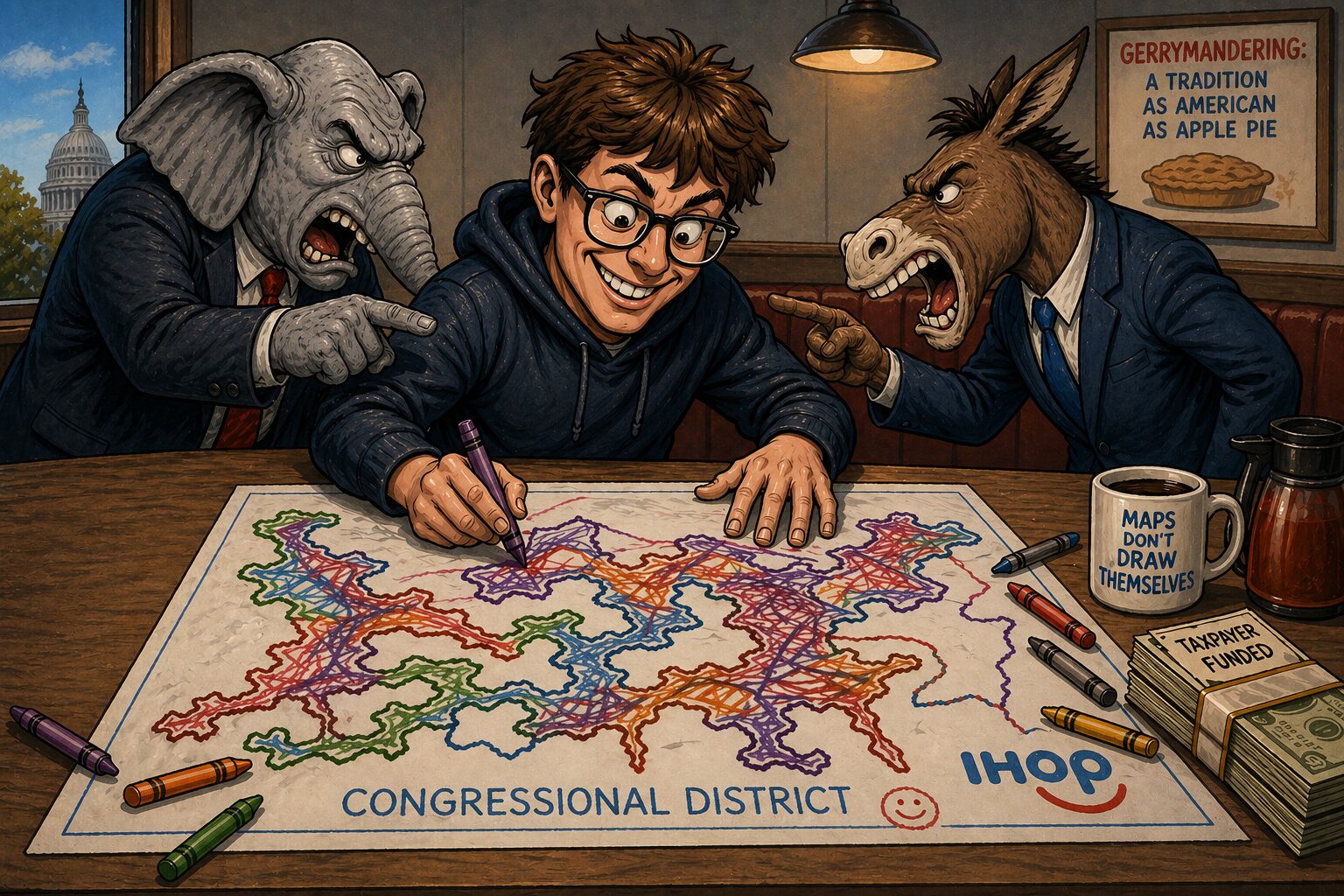
Gerrymandering. It’s a tradition as American as baseball, wasteful government, and urban blight. And like most issues facing Americans today, is it of the sort where everybody suddenly discovers principles only when the other side is doing it. Republicans complain about Democratic gerrymandered maps, Democrats complain about Republicans doing it as well, and both are right. But both are also usually full of it, because the second they get the pen, they do exactly the same thing.
This is nothing new. Patrick Henry tried to draw James Madison out of Congress before Madison had even gotten there. Elbridge Gerry gave the practice its name more than two centuries ago. And somewhere, in some state capitol, a twenty-two-year-old consultant is undoubtedly being paid handsomely to use AI to draw a congressional district that looks like a child’s scribble on an IHOP placemat.
But the fact that something is old does not make it noble. A tradition can be longstanding, deep-seated, and thoroughly American without being either elevating or constitutional. Some traditions deserve preservation, but others, like gerrymandering, deserve burial.
Look at New England. There is not a single Republican member of Congress in the entire region, even though roughly 41% of the population there is Republican enough to have voted for Trump in 2024. New Jersey, which gave 46% of its vote to Trump, has three Republicans out of twelve seats. Maryland has one Republican congressman out of eight. Florida and Texas are ridiculous in the Republican direction. And now Virginia is fighting over a map that could turn a closely divided state into something like a Democratic monopoly.
This is not democracy, it is cheating with graph paper. And the Supreme Court of the United States deserves a lot of blame for allowing it. In Rucho v. Common Cause, the Roberts Court basically looked at one of the most obvious distortions in American politics and said, “Not our problem.” It was a 5-4 decision, with the five conservative justices — Roberts, Thomas, Alito, Gorsuch, and Kavanaugh — forming the majority, and the liberal wing dissenting. The liberals were right. They were! We have to be fair. The conservative majority dressed up their decision in the language of the political question doctrine, but the practical result was surrender.
It could not possibly be more obvious that the Constitution does not just create elections, it creates representation. It does not refer to members of Congress as “functionaries,” or “temporary placeholders.” They are called “Representatives,” and that word has to mean something. The Court had a chance to say that the constitutionally created “House of Representatives” must actually be representative — what could be more conservative than that? — and it refused.
No, the Constitution does not require perfect proportional representation. Nobody is saying that if a state votes 52.6 percent one way, the delegation must precisely reflect that down to the decimal point. Geography and communities matter, as do the candidates and the campaigns and the issues. Districts have to exist in real places. But there is a very big difference between unavoidable imperfection and intentional distortion.
If a state votes 60-40, the delegation should not be 90-10. If a state is basically split down the middle, one party should not dominate. The goal should be simple: draw districts that represent intact communities, not random groups with little in common which are thrown together for no purpose other than to gain electoral advantage, while producing a map that, above all else, comes as close as practicable to reflecting how the state actually votes.
That should be the test. Whichever proposed map best reflects the real statewide vote, while still following ordinary geographic rules, should win. And if the political parties can’t do it, then the federal courts should step in, because obviously, the state courts aren’t doing a very good job. And why would they? Look at New Jersey: Democrats and Republicans both get to propose maps, but it being a Democrat state, the Democrats always have the tiebreaking vote so their map always wins, and it gets reviewed by a state supreme court that’s been appointed by Democrats and, shockingly, the Democrat maps are always approved and nothing ever changes.
This is not just a technical fight over maps. It goes to the basic promise of representative government. The voters are supposed to choose their representatives. The representatives are not supposed to choose their voters, and apportion them in such a way to create political advantage inconsistent with the vote. And until the courts are willing to say that out loud, both parties will keep doing what they are doing, weaponizing government against each other, tugging at the very fabric of our democracy until it finally rips.
You may also be interested in: