

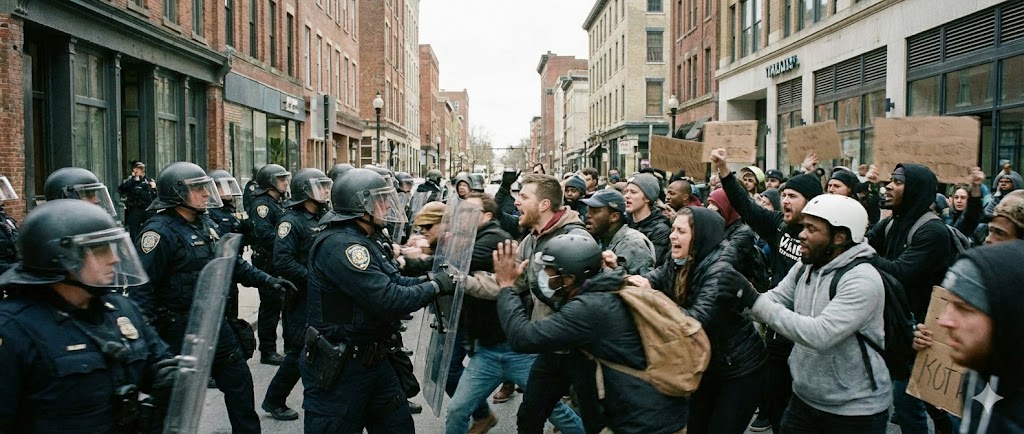
There is a crucial distinction in any free society, one that is increasingly being blurred, if not deliberately erased. You can protest against law enforcement. You can protest against laws themselves. You can march, speak, vote, litigate, and work to change policy through democratic means. That is not only permitted in a free society, it is essential to one.
But once you cross the line from protest into interference with the execution of the law, you have placed yourself in the same moral category as those who sought to interfere with lawmaking itself on January 6. The difference between, for example, protesting immigration laws and obstructing their enforcement, is the difference between democracy and mob rule.
January 6 was an attack on the democratic process by which laws are made. Obstructing immigration enforcement is an attack on the process by which those same laws are carried out. Both reject the legitimacy of democratic authority when it produces outcomes one dislikes. And if law is being improperly enforced, that’s why we have lawyers. We loathsome, bottom-dwelling ambulance chasers actually do come in useful for something other than a punchline occasionally.
You can oppose a law. You can even despise it. But you cannot claim to defend democracy while actively obstructing it.
Similarly, you have a right to carry a gun to a protest. But rights do not exist in a vacuum. They carry responsibilities, especially when the right in question involves lethal force. If you confront a police officer, or officers, and you are armed — legally or not — you have created a potentially dangerous situation for yourself and the officers, that can have deadly consequences.
That does not, of course, absolve law enforcement of exceeding their authority if they improperly use lethal force. It is simply to observe the obvious: an armed person creates a heightened danger for everyone involved, including himself. And while we can litigate against the department or officers later, that does not bring the protester back to life.
This is why, by the way, those of us who are licensed to carry are required to alert law enforcement that we are carrying if we interact with them. That’s the first thing we do if we are pulled over: “Good afternoon, officer. I need to make you aware that I am licensed to carry and that I am carrying a firearm.” How hard is that?
In fact, I was speaking with an officer the other day about a situation where he was approaching a driver on a routine motor vehicle stop, and, like an idiot, the driver unholstered his pistol to place it in the glove box just as the officer was approaching the window, so all the officer saw was this guy pulling his gun out at him. The officer had to make a split-second decision about whether to defend himself. Thankfully, in that split second the driver relented, but it was very close to a bad situation.
That driver was not acting maliciously. He was acting stupidly. And stupidity, when combined with a firearm, can be fatal.
The point is not that people acting lawfully deserve to be shot. The point is that responsibility matters. A gun is not a political symbol. It is a tool that carries irreversible consequences when mishandled. Even when you legally own and carry it, you do not have the right to do so in a way that creates a dangerous situation for those around you.
And let me be clear about this: I have not said that either of the recent deaths involving ICE officers was justified. I have not reached a conclusion about the use of force in those cases, and I don’t pretend to have enough information to do so. I’ve learned over the years that the first version of any story is almost always incomplete, and often wrong. That’s especially true in situations like this, where events unfold quickly, emotions are high, and the available video tells only fragments of the story.
As a lawyer, I’m accustomed to reviewing hundreds of pages of discovery, and many gigabytes of videos, for even one simple case. I can’t make an informed judgment on a few fragments of videos and nothing else. In these two cases in Minnesota, I’ve only seen pieces of what happened. I don’t have statements from the officers involved. I don’t know the full sequence of events. And I don’t think it’s responsible to rush to judgment based on partial information or social-media clips. Even video can be misleading depending on the angle and what happened before the recording started. Just because a video might be real does not mean it tells the whole truth. From what snippets I’ve seen of the most recent incident, things happened very quickly and chaotically, and I cannot make out heads from tails from the footage I’ve watched so far.
The only claim I have made is a limited one: that the mere fact someone had a legal right to carry a firearm does not automatically make every outcome involving that firearm unjust. I did not say the killing was justified. I do not know if it was. A case like this would take me weeks to review the evidence, and I’ve seen none of it. All I’ve said was that the right to carry a weapon carries special responsibilities, and that irresponsible behavior while armed can create an extremely dangerous situation for everyone involved.
We should care deeply when life is lost. But caring deeply is not the same as reacting recklessly. And on the topic of caring, what troubles me most about these moments, beyond the tragic loss of life, is how quickly we turn on one another.
We are not each other’s enemies. Evil works that way. We are not belligerents in a civil war. We are not divided into moral castes of good and evil. We are friends, colleagues, neighbors, brothers and sisters, all created in the image of God, and — whether we like it or not — participants in a shared civic project. That’s true regardless of race, faith, immigration status, gender, or political affiliation, and every other way we’re divided as part of a thinly veiled divide-and-conquer strategy that radicals on both sides are eager to exploit. And I hate how trite that sounds, but it also happens to be true.
The loss of life is terrible. We are not. We can debate issues without turning on one another. None of us here attacked law enforcement or shot anyone. We can demand accountability for wrongdoing, whoever committed it. But more than that, we can care deeply without personifying the very hatred we claim to oppose.
We have nothing to hate but hate itself.
I would be remiss if I did not conclude by proposing a path forward. Conservatism, after all, must always be solution-oriented. And there is a solution, found in a fairly broad and obvious consensus among Americans:
- Borders should be secured;
- Immigration should be merit-based;
- Genuine asylum claims deserve individual consideration;
- Deportations should prioritize criminals;
- Long-term, law-abiding residents should have some opportunity to apply for legal status, with appropriate penalties;
- Taxpayer resources should be reserved for citizens; and
- There is a strong distaste for a heavy law-enforcement presence, such that its deployment should be rare, brief, and only when absolutely necessary.
This presents an opportunity for leadership. MAGA needs to understand that making America great looks less like a police state and more like building consensus, so we don’t tear the country apart at the seams. Conservatism means governing with restraint, wisdom, and an understanding that stability matters. The alternative — constant escalation, moral absolutism, and perpetual outrage — is precisely what destroys the very republic conservatives seek to conserve.
I do not argue for less passion, only more perspective. Politics is not a religion. It is not a purity test. It is the art of the possible: of compromise, judgment, and restraint. Sometimes that means accepting outcomes we dislike in order to preserve a system that allows disagreement without violence. That kind of restraint is not weakness. It is the price of keeping a civilization intact. And in moments like this, it may be the most conservative virtue of all.
You may also be interested in: